
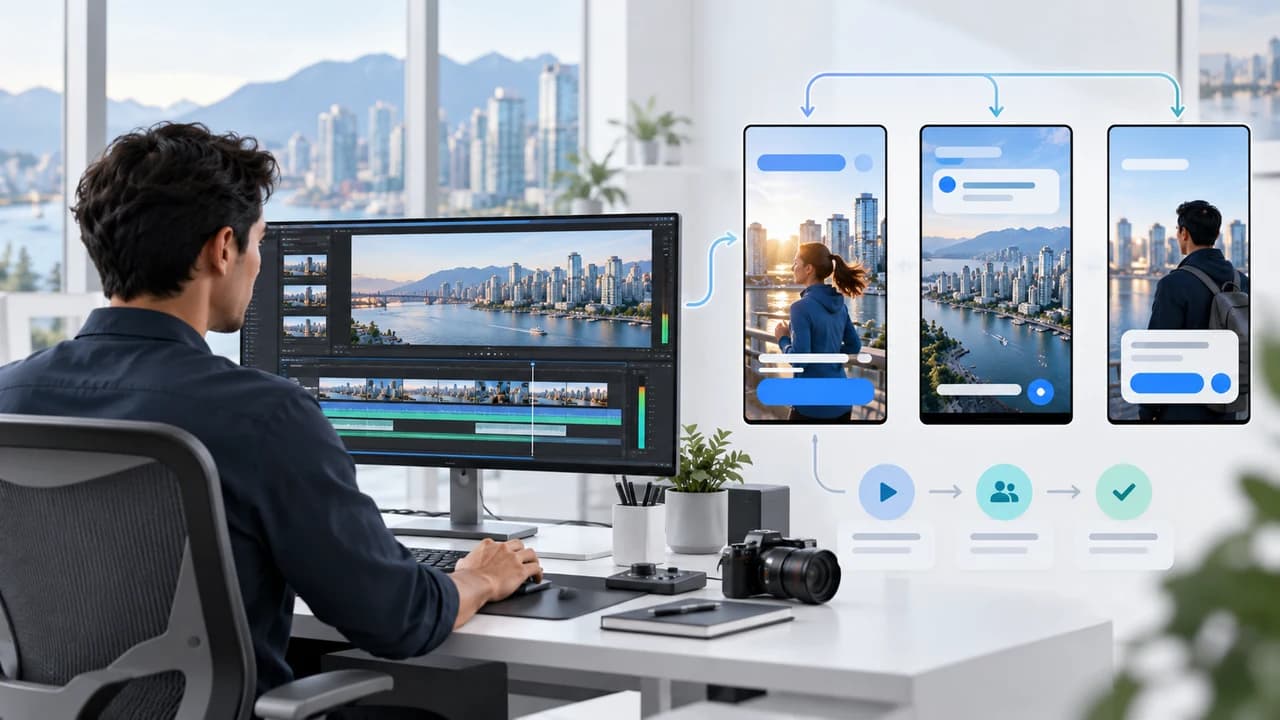
Corporate video social media cutdowns Vancouver teams can approve with a hook, caption and CTA matrix.
Corporate video social media cutdowns Vancouver teams can define before editing
Corporate video social media cutdowns Vancouver marketing teams request should not begin with an instruction to make the main film shorter. A useful cutdown has a specific audience, placement and next action. If those decisions are missing, the editor can produce three polished clips that repeat the same introduction, bury the strongest moment and end without a clear reason to respond.
Start with the approved corporate promo and write down what it already proves. Identify the strongest customer problem, product demonstration, founder statement, team moment or result that appears in the footage. Then choose three different viewer tasks that the existing material can honestly support. One edit might introduce the company to people who have never heard of it. A second might answer a practical objection for prospects comparing providers. A third might invite viewers to a consultation, event or product page. These are three editorial jobs, not three arbitrary durations.
Create one row for each cutdown before opening the timeline. The row should name the audience, placement, single message, opening hook, supporting shot or quote, caption approach, call to action, aspect ratio, target length, reviewer and publication date. Mark any requirement that the source footage cannot meet. A missing close-up, unsupported claim or unavailable clean logo animation should be resolved through a simpler edit, approved graphic or new capture—not disguised with generic stock.
A Vancouver corporate video production brief can plan these secondary uses while the main film is being made, but the same matrix also works when a company already owns an approved master. The important shift is to treat each social edit as a small communication product with its own approval criteria.
Give each of the three edits a different opening hook
The first visible and audible beat should make sense to somebody who has not watched the full corporate video. Do not assume the platform caption, post copy or company profile will supply the missing context. For each cutdown, write a one-sentence hook promise: what will the viewer understand if they keep watching? Then choose a source moment that delivers that promise quickly without changing its meaning.
Cutdown one can be problem-led. Open with a recognizable buyer frustration, followed by the clearest visual or statement showing how the company approaches it. Cutdown two can be proof-led. Begin with an approved demonstration, customer observation or concrete process detail, then explain why it matters. Cutdown three can be people-led. Start with a founder, specialist or team member saying something specific enough to reveal how the business works. A title card that only repeats the company name is branding, not necessarily a hook.
Build the opening from footage the viewer can interpret immediately. A quotation pulled from the middle of an interview may require the missing question or previous sentence. Review the full answer before moving it. If shortening changes who or what the speaker refers to, include the necessary setup or choose another line. Never turn a cautious statement into a guarantee by removing a limitation. The cutdown must remain accurate even when separated from the master film.
Add the chosen hook, backup hook and source timecode to the matrix. The backup matters because a strong line may fail in a vertical crop, carry distracting background sound or depend on a shot that cannot be cleared for social use. Approve the hook in context before the editor builds the remaining sequence. That small decision keeps three versions from converging into the same generic opening after multiple reviewers begin suggesting alternatives.
Design captions and safe areas for the actual placement
Captioning is not a final checkbox. It affects framing, shot selection, graphics and pace. The brief should say whether the edit needs burned-in captions, a clean version, a separate caption file or a combination. It should also identify language, spelling reference, brand terms and the person responsible for checking names and technical words. Automatic transcription may provide a draft, but the published copy still needs a human review against the approved audio.
Ask for one layout proof early: a representative frame showing the subject, captions, any identifier and the proposed call to action. Review it at phone size rather than only on a large desktop monitor. Check whether captions cover hands, products or demonstrations; whether a face is pushed into an awkward crop; and whether essential information sits too close to interface areas. Platform interfaces and placements can change, so use the current delivery specification supplied for the campaign rather than relying on an old universal template.
The three cutdowns do not need identical caption density. A fast problem-led edit may need short phrases and more visual breathing room. A proof-led edit may require a measured pace so a process or comparison can be understood. A people-led edit should preserve natural speech rather than forcing every sentence into the same rhythm. The goal is readability and meaning, not filling every moment with animated words.
List the required versions beside each row in the matrix. If the team needs a vertical captioned file, a clean vertical file and a horizontal archive, those are separate outputs and should be scoped and reviewed as such. The social media video pricing page is a useful starting point for comparing production, retainer and edit-only needs, but the quote still depends on source quality, number of versions, graphics, caption languages, review rounds and deadline.
Write one CTA that matches each viewer's next step
A social cutdown should end with a next step that follows naturally from the message. Repeating the same contact us card on all three versions may be convenient, but it ignores the viewer's stage of awareness. The problem-led edit might direct a viewer to learn how the service works. The proof-led edit might point to a relevant case example or detailed service page. The people-led edit might invite a conversation when trust and fit are the main decision.
For every row, write the CTA in plain language, identify the destination and name the owner who verifies it before export. Confirm that the linked page is live, mobile-friendly and consistent with what the video promises. If the campaign uses a landing page, event registration or limited offer, record the publication window so an old cutdown is not reposted with an expired destination. Avoid placing a long URL or several competing actions into a few seconds of screen time.
The CTA also changes the preceding edit. A request to book a call needs enough context for the viewer to know what the call concerns. A prompt to watch the full film should leave a useful unanswered question rather than summarize everything. A request to save or share a practical tip should actually deliver a tip worth keeping. If the available corporate footage does not support the chosen action, revise the CTA instead of adding a stronger claim in graphics.
Read the hook and CTA together. They should describe one coherent exchange: the opening earns attention with a relevant promise, and the ending offers the next reasonable step. Put both lines in the matrix before stakeholder review. This makes it easier to spot when one department has approved the opening while another has replaced the ending with a different campaign objective.
Use one approval matrix instead of three separate feedback chains
The approval matrix should let a reviewer compare all three edits without turning them into copies of one another. Give each version an ID and include audience, placement, hook, core proof, CTA, caption treatment, crop, duration range, rights notes, reviewer and status. Add links to the current proof files and keep older versions available but clearly marked as superseded. A filename such as final-final-new does not tell the team which decisions it contains.
Assign responsibilities by subject. A brand owner checks visual identity and tone. A subject-matter owner checks claims and technical language. A communications or legal reviewer checks permissions and required wording where applicable. One marketing owner consolidates those comments and approves the publishing objective. The editor should receive one decision set with timecodes, not several conflicting message threads. If reviewers disagree, the owner resolves the objective before asking for another export.
Review in two passes. The first pass checks whether each cutdown performs its distinct job: the right audience, hook, proof and CTA. The second checks execution: caption accuracy, crop, audio, graphics, colour, names, logos, end frame and file specification. Separating purpose from polish prevents a team from spending time adjusting caption animation on a version whose message has not been approved.
Record scope changes rather than slipping them into ordinary revisions. A new audience, newly recorded voiceover, extra language, different campaign claim or additional aspect ratio may require new editorial work and another quality-control pass. The matrix makes that change visible. It also creates a reusable record when the company returns months later to update a caption or CTA, because the team can see which source, permission and decision produced the published file.
Send a complete cutdown brief and test all three exports
Before editing begins, package the approved master, original or high-quality source footage if available, brand files, music and footage licence notes, transcript, spelling and pronunciation references, current platform specifications and the completed three-row matrix. Identify anything that cannot be changed because the main film has already been approved. Also state whether the social versions may reorder statements, use alternate takes or add graphics that were not present in the master.
When proofs arrive, watch each one in the context in which it will be used. View the vertical export on a phone, once with sound and once muted. Confirm that the first frame is understandable, captions remain readable, the visual proof matches the spoken claim and the CTA stays on screen long enough to register. Then compare all three versions together. They should feel related to the same campaign while serving distinct viewer tasks. If changing only the opening sentence would make the files interchangeable, the brief has not created enough separation.
Run a final file check after approval. Confirm dimensions and orientation against the supplied delivery requirement, audio presence, caption version, language, spelling, current CTA destination, approved music or footage, filename and archive location. Save the signed-off matrix with the exports. Publishing teams should be able to tell which file belongs to which audience and destination without opening every video.
To scope three purposeful edits from an existing corporate promo, contact Steven Video Production with the master video, intended audiences, publication placements, deadline, caption languages and desired actions. Those inputs are enough to identify what can be created from the current material, what needs a simple graphic or pickup shot, and which deliverables should be included in the quote.
Frequently Asked Questions
What is a corporate video social media cutdown?
It is a shorter edit built from a corporate video for a defined social audience and placement, with its own hook, proof, caption treatment and call to action—not simply a trimmed master.
Can one corporate promo become three different social videos?
Yes, when the source contains enough distinct material. Assign each cutdown a separate viewer task, such as introducing the company, answering an objection or inviting a specific next step.
Should every social cutdown use the same hook?
Usually no. A problem-led, proof-led and people-led opening can serve different audiences while staying faithful to the same approved corporate story.
Do social media video cutdowns need captions?
Plan caption requirements for each placement. Confirm language, spelling, layout, safe framing and whether you need burned-in, clean and separate caption-file versions.
How much do corporate video cutdowns cost in Vancouver?
Cost depends on source-footage condition, number of edits and aspect ratios, caption languages, graphics, rights checks, review rounds and deadline. A complete matrix allows an itemized quote.
Who should approve corporate social video edits?
Use named reviewers for brand, factual claims and permissions, with one marketing owner consolidating comments and approving each cutdown's audience, hook and CTA.
Ready to start your project?
Get in touch for a free consultation. I typically respond within a few hours.