
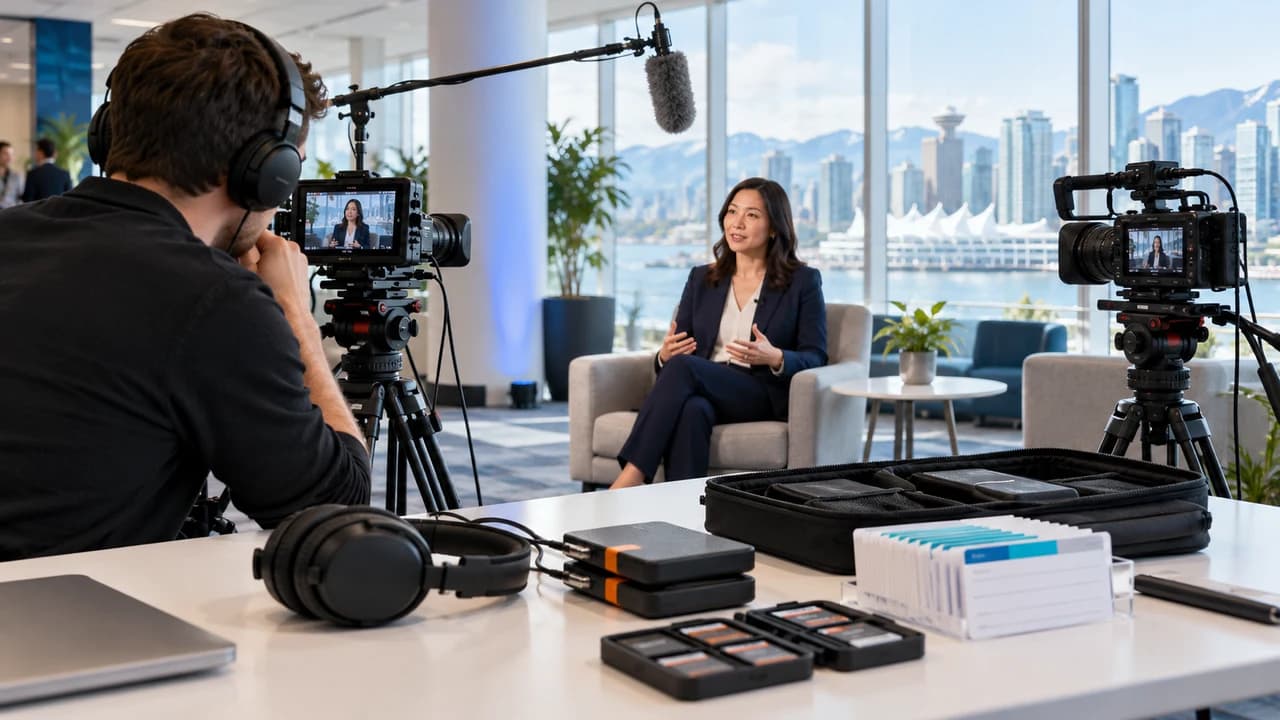
Corporate event interview recording Vancouver checklist for cameras, clean audio and footage handoff.
Plan corporate event interview recording Vancouver around the final use
Corporate event interview recording Vancouver works best when the producer knows where the interviews will appear before arriving at the venue. A two-minute conference recap, a set of individual speaker clips and internal archive footage call for different questions, framing and recording time. Start with the final deliverables: approximate length, horizontal or vertical format, captions, language versions, publishing channels and whether the client expects edited videos or organized camera files. This keeps a short interview station from turning into an undefined request to capture everything.
The venue schedule sets the practical limits. Identify when speakers are available, how far they must walk from the stage or booth, and whether the interview area will still be accessible during room changes. Ten minutes on the calendar rarely means ten minutes of usable recording. The guest may need a microphone fitted, their name and title checked, the question explained and one answer repeated after an interruption. A realistic slot leaves time for those steps without making the speaker late for the next session.
Choose one person to own the interview list. That contact confirms priority guests, correct spellings, job titles, preferred language, consent status and the topics each person can address. The crew should also know who may be filmed only for internal use and who has approved public promotion. For a larger program, our Vancouver event videography service can combine scheduled interviews with conference coverage, but the interview brief still needs its own owner. A clear purpose, speaker list and release plan give the camera and audio decisions something concrete to support.
Choose one or two cameras based on the edit
A single well-placed camera is often enough for short testimonials, quick attendee reactions or interviews that will use plenty of event b-roll. It is faster to set up in a tight venue and easier for one operator to manage. The main camera should record a stable medium close-up with enough room for captions and any required crop. If vertical clips are planned, decide whether to record a separate portrait angle or frame the horizontal image with enough resolution and safe space for a deliberate crop.
A second camera earns its place when the edit needs clean cuts between longer answers, when several short clips must be produced from one conversation, or when the interviewer will appear on screen. The second angle should be meaningfully different, usually tighter or positioned off the same eyeline. Two nearly identical frames do not hide an edit well. Both cameras need matching frame rate, white balance, picture profile and time settings. The operator should confirm focus and recording on each take instead of assuming the second body is still rolling.
Camera count also affects staffing. One person can operate a locked second angle while monitoring the main camera and sound, but that plan becomes fragile if the location is crowded, the interviewer moves, or the event itself also needs active coverage. In those cases, add an operator or simplify the interview setup. Ask what moment matters more if two things happen at once: the keynote, the sponsor activation or the interview. The answer should shape the crew plan. Equipment should follow the edit and schedule, not serve as a visual display for the client.
Treat the room as part of the audio system
Event interviews are usually lost to sound before they are lost to picture. Conference venues contain HVAC noise, music, applause, rolling cases, espresso machines and conversations from every direction. Walk the venue before choosing the background. A visually attractive lobby beside registration may be much harder to use than a plain room twenty metres away. Listen during the same part of the schedule when interviews will happen, since an empty morning hallway can become a lunch queue later.
Place the speaker away from hard walls and loud doorways, then bring the microphone close. A discreet lavalier gives a consistent level when the person turns slightly. A boom or compact directional microphone can provide a clean primary track or backup if clothing noise affects the lav. Record both to separate channels where the setup allows it, and monitor with closed-back headphones. The meter can show a healthy signal while the recording still contains rubbing fabric, wireless interference or a refrigerator hum.
Record a short test with someone speaking at the expected level. Check the full signal path, then capture room tone for editing. If the event includes amplified music or a public-address system, do not assume a board feed will solve the interview. The feed may contain stage microphones, music or announcements, while the interview needs a close, isolated voice. The quote should state whether the crew is recording interviews only, taking a venue feed, mic'ing stage speakers or doing all three. Event video pricing and coverage options help establish the filming window, but final audio requirements should be confirmed against the actual venue and program.
Build a repeatable interview station and question flow
A repeatable station saves time when several people are recorded between sessions. Mark the speaker position, camera tripods, microphone route and a safe place for bags. Keep exits, service paths and fire routes clear. A small sign or staff member can reduce people walking through the background. If the event brand must appear, use a real booth, stage detail or approved backdrop without forcing a logo directly behind the speaker's head. Check screens for flicker and confidential information before recording.
Use a short question list that invites complete answers. Ask the speaker to include enough context that the editor can remove the interviewer if needed. Instead of requesting a general comment on the event, ask what problem brought them there, what idea they will take back to work, or what surprised them in a specific session. Confirm whether the client needs a testimonial, subject expertise, event feedback or a concise statement for a recap. One interview should not be pushed to serve every purpose.
Before the first answer, record the person's name, title and organization for reference, then verify the spelling against the approved list. Keep this identification separate from the usable answer unless the client wants an on-camera introduction. Watch for interruptions and restart the answer promptly when a door slams or an announcement begins. At the end, capture a few seconds of the speaker listening or settling, plus any requested alternate line. A consistent routine reduces missing names, unusable sentence fragments and rushed handoffs while keeping the interaction comfortable for guests.
Define raw footage handoff before the event
Raw footage can mean camera originals, selected clips, synced interviews, proxy files or every card copied exactly as recorded. Those are different deliverables. Camera originals may include false starts, microphone fitting, setup conversation, flat colour profiles and files that require professional software. Synced and organized material takes more time because someone must match camera and audio, label speakers, remove obvious technical failures and build a usable folder structure. The quote should say which version the client will receive.
Agree on file format, transfer method and delivery timing. A full event can produce hundreds of gigabytes, so a download link may be slow or impractical. The client may need to supply an approved drive, pay for media, or receive proxies first and originals later. Decide whether the handoff includes separate audio, venue feeds, release notes, interview transcripts, thumbnails or an edit project. Music, stock assets, fonts and plug-ins used in an edited project may have licence restrictions and are not automatically transferable with source files.
Use a simple folder structure: date and event, camera originals by camera, audio by recorder, interview selects or synced sequences, documents and final exports. Add an index listing each speaker, filename range, language, consent or usage note and known technical issue. State how long the production keeps a backup after verified delivery. The client should copy the material to its own storage and confirm that the files open before the production archive is cleared. A useful handoff gives the next editor enough context to work without pretending that unedited footage is a finished public record.
Approve the checklist, scope and fallback before doors open
The final pre-event call should confirm the interview purpose, priority speakers, schedule, location, camera plan, audio method, client contact, consent process, deliverables and handoff. Add practical constraints such as loading access, parking, credentials, power, venue rules and the time by which equipment must leave. If a quiet room cannot be guaranteed, agree on a fallback: move to a nearby office, record shorter statements with a close microphone, or schedule selected speakers before guests enter.
Name the person who can make trade-offs during the event. When a speaker is available at the same time as an unrepeatable stage moment, the crew needs a priority decision. When the approved room becomes noisy, someone must accept the alternate background. Keep these choices with one informed client contact instead of waiting for several people to reply. After filming, the same owner should verify names and consolidate edit notes.
The exact search volume for corporate event interview recording Vancouver is unknown. Recent OpenSEO GSC data did show 2 impressions for the related query event video bc during October 16 to 22, 2026, but that small observation is not a demand estimate. The production decision should come from the event's communication plan: who needs to speak, what the organization needs from them, and how the recordings will be used.
For a project-specific plan, contact Steven Video Production with the event date, venue, program, expected speaker count, publishing channels and whether you need edited clips or footage handoff. Those details are enough to recommend a camera and audio plan without padding the scope with equipment the edit will not use.
Frequently Asked Questions
How many cameras are needed for a corporate event interview?
One camera is often enough for short answers supported by event b-roll. Use two meaningful angles for longer interviews, interviewer-and-guest coverage or edits that need frequent clean cuts.
What microphone is best for interviews at a conference?
A close lavalier or directional boom microphone usually works better than a camera-mounted mic in a noisy venue. Recording two separate microphone channels gives the editor a practical backup.
How long should each event interview slot be?
Allow time for mic placement, identity checks, the question, a repeated answer and interruptions. A ten-minute calendar slot will normally produce less than ten minutes of actual recording.
Is raw footage included with event videography?
Do not assume it is included. The quote should define camera originals, separate audio, synced material, proxies, drives, transfer time, organization and archive period.
How much does corporate event interview recording cost in Vancouver?
Cost depends on coverage hours, camera and audio crew, venue conditions, speaker count, editing, captions, delivery versions and whether organized raw footage is required.
What should the client provide before event interviews are filmed?
Provide the schedule, priority speaker list, correct names and titles, consent status, venue access, intended uses, required formats and one contact authorized to make decisions on site.
Ready to start your project?
Get in touch for a free consultation. I typically respond within a few hours.