
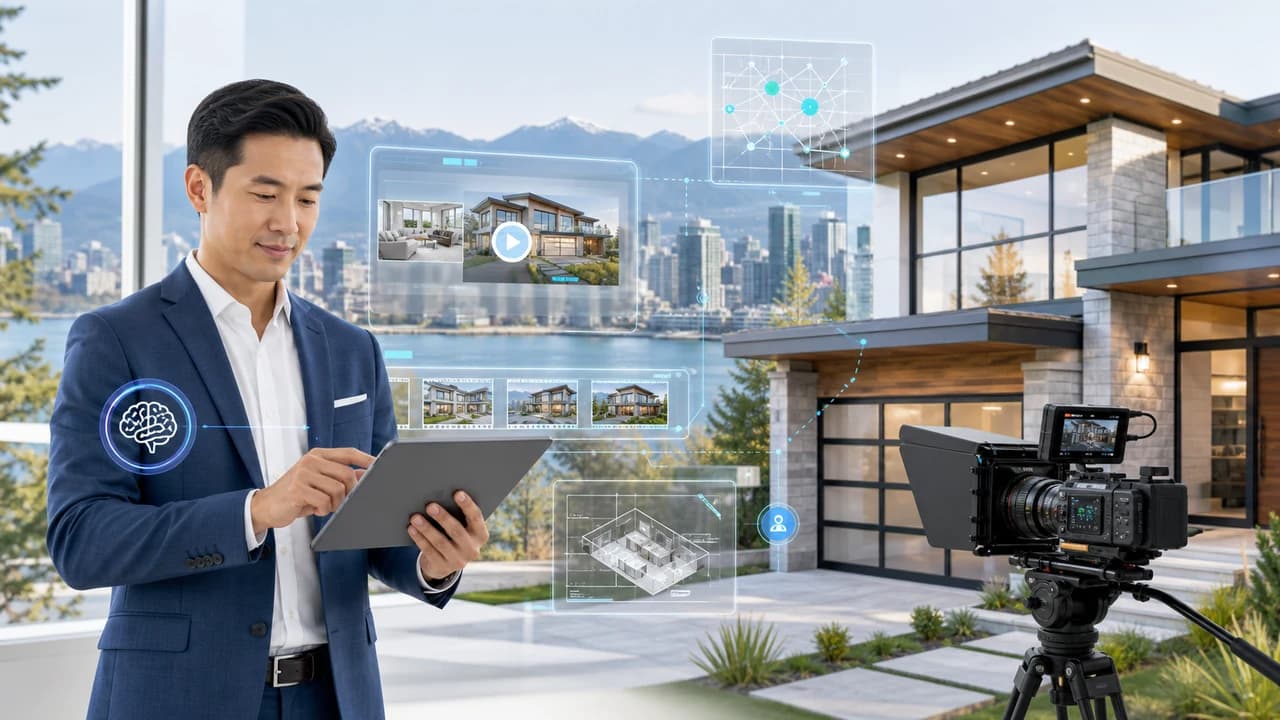
AI real estate video Vancouver agents can use for social teasers, planning, and faster edits—without compromising buyer trust on the main listing.
AI Video Is Entering Vancouver Real Estate Marketing in 2026
AI real estate video Vancouver agents are exploring can make social teasers, planning, and post-production much faster—but it cannot replace accurate footage when buyers are deciding whether to view a property. The Metro Vancouver and Richmond listing market is competitive, visual content drives click-through rates on MLS and social platforms, and producing video content for every listing used to require a separate budget line. In 2026, a new category of AI tools is changing the economics of that decision.
The tools that are actually gaining traction are not trying to replace professional video production entirely. They are serving two specific gaps: the gap between listings that justify full professional shoots and listings where the budget does not support one, and the gap between major content investments and the ongoing social media content that every agent needs to stay visible. Those two gaps are where AI tools are genuinely useful right now.
For Vancouver agents working in Richmond, Burnaby, North Vancouver, and greater Metro Vancouver, the right question is not whether to use AI tools or professional production, but which situations call for which approach. This guide walks through what agents are using, where AI video works, where it does not hold up under buyer scrutiny, and the hybrid approach that gets the most from both.
AI Video Tools Real Estate Agents Are Using Right Now
The AI tools most commonly adopted by Vancouver real estate agents in 2026 fall into three categories: image-to-video generation, virtual staging and space visualisation, and AI-assisted video editing for social content.
Image-to-video generation tools like Seedance, Kling, and Veo 3 can take a high-quality property photo and animate it — adding subtle motion to a room, simulating a slow camera push toward a fireplace or garden, or creating a brief aerial-style movement from a single exterior shot. The output can look impressive for social media teasers when the source photo is excellent and the motion is kept minimal and natural. The practical limit is that the motion must be simple, the source image must be sharp and well-lit, and the result will not hold up at full-screen viewing.
Virtual staging and space visualisation tools use AI to replace empty or dated furniture in listing photos and videos with staged alternatives. This has existed as a photo editing service for years, but 2026 AI tools can apply it to video frames more quickly and at lower cost. For vacant properties or estate sales where physical staging is impractical, AI staging can help buyers visualise the space's potential, but agents need to clearly mark AI-staged content as such to comply with disclosure requirements.
AI-assisted video editing tools are useful for agents producing their own market update videos, community tours, and educational content for YouTube or Instagram. Tools that automatically cut a long recording to highlights, add captions, resize for vertical formats, and suggest background music can reduce the technical barrier for agents who want to produce consistent social content without hiring a video editor for every piece.
Where AI Video Works Well in Property Marketing
AI video tools deliver genuine value in property marketing for a specific set of use cases where speed, volume, and social media distribution matter more than credibility and fine detail.
Social media teasers for MLS listings: A 15 to 30-second animated version of the hero photo can go up on Instagram, Facebook, and WeChat the same day the listing goes live, before professional video is ready. For agents posting multiple listings per week, this volume of content production would be impractical with traditional video production. AI tools make it achievable.
Market update and educational content: AI editing tools make it practical for an agent to record a 10-minute walk-and-talk about market conditions, then get an AI-generated highlight cut, captions, and social resize done in an hour. This type of content builds audience and demonstrates market knowledge. It does not require the production quality of a listing video.
Concept and narrative planning for real shoots: Before investing in a full real estate video production day, AI-generated concept sketches, animated storyboards, or rough motion tests from existing photos can help align the agent, the homeowner, and the production team on the visual direction. This is the use case where AI saves money on production by reducing the expensive re-shoots and creative pivots that happen when everyone is guessing at the final result.
Content between listing dates: During periods between active listings, agents need to stay visible on social media without a production budget for every post. AI-animated market data charts, short explainers, and community spotlight content can fill the calendar without requiring a shoot day for each one.
Where AI Video Falls Short for Serious Real Estate Listings
The limit of AI video in real estate is clarity: buyers need to trust that what they see represents what they will find. When AI-generated content is used for a listing video — even with good intentions and technical skill — it introduces questions about what is real that a professional video would not.
For high-value Vancouver and Richmond listings — detached homes, luxury condos, presale developments — listing video credibility directly affects buyer confidence and showing rates. A buyer who clicks through from a polished AI-animated social teaser and then sees a listing with only photos or a basic walkthrough on the main MLS page has a gap in their experience that raises questions rather than building confidence. The most effective approach for these listings is professional video on MLS, with AI teasers as a supplement on social channels.
AI video also cannot capture what makes a Vancouver property worth its premium: the quality of the light through the west-facing windows in the late afternoon, the way the North Shore mountains appear from the terrace, the sound and scale of a property in an actual neighbourhood. These sensory details communicate in real footage and are nearly impossible to simulate convincingly with AI tools in 2026.
Disclosure and trust: Agents using AI-staged or AI-generated content in listing materials should be aware of REBGV marketing guidelines and MLS listing requirements. AI staging that is not disclosed as AI staging has drawn complaints in Canadian markets and carries reputation risk. The standard is to label AI-modified content clearly and not use it as the primary representation of a property's actual current condition.
For listings where the agent wants to move fast, manage costs, and still maintain buyer trust, the practical solution is hybrid: use AI tools for social teasers and content between listings, and book professional video for the primary MLS listing, open house marketing, and any content where buyer decision-making depends on what they see.
The Hybrid Strategy: AI Planning Plus Real Production
The Vancouver agents who are getting the most from both AI tools and professional production are treating them as different stages of the same content strategy rather than competing options.
Before the shoot: AI tools help plan the video — generating virtual staging tests, testing different exterior motion angles from existing photos, and producing concept sketches that the agent, homeowner, and videographer can align on before shoot day. This planning step reduces on-set decision time and makes the actual shoot more focused.
On shoot day: Professional real estate videography captures what only real footage can — actual lighting conditions, accurate spatial relationships, the neighbourhood context, and the property's true character at a specific moment in time. Interior walkthroughs, kitchen and bathroom detail shots, natural light through windows, and exterior presence all benefit from a professional camera operator with proper lighting, stabilisation, and audio.
After delivery: The professional video goes to MLS and the property website. From the same footage, AI-assisted editing can produce social cutdowns faster, generate captions for multiple languages (English, Mandarin, Cantonese for Vancouver's diverse buyer pool), and resize for every relevant platform. The AI editing layer multiplies the value of the professional shoot without replacing it.
Between listings: AI-generated social content fills the calendar and keeps the agent visible, while the production budget concentrates on listings where real video investment makes a measurable difference to marketing outcomes.
For Vancouver and Richmond listings where you want to explore what a professional video combined with an AI-extended content strategy can look like, view the real estate video portfolio or contact Steven Video Production to discuss your next listing.
Frequently Asked Questions
Can AI create real estate listing videos in Vancouver?
AI tools can create social media teasers, animated photos, and concept content, but not a primary MLS listing video that represents the property accurately to buyers. For the main listing video — the one that drives showing appointments — professional footage is more credible and converts better.
What AI video tools are Vancouver real estate agents actually using?
Image-to-video tools (Seedance, Kling, Veo 3) for social teasers from listing photos. Virtual staging AI for vacant properties. AI editing tools (Descript, Captions.ai) for market update videos and social cutdowns. Most agents use these as supplements to professional production, not as replacements.
Does AI-generated property content affect buyer trust?
Yes, especially for high-value listings. Buyers clicking from an AI-enhanced social teaser to a listing with only photos on MLS experience a credibility gap. AI staging that is not disclosed as such also carries disclosure and reputation risk. Clear labelling and using AI as a supplement rather than a primary representation protects both agent and buyer.
How does AI video compare to real drone footage for listings?
AI-simulated aerial-style motion from a ground photo does not replicate licensed drone footage. Real drone footage shows accurate neighbourhood context, lot size, proximity to features like water or mountains, and is appropriate for MLS and property websites. AI animated photos are suitable for social teasers only and should not be presented as actual aerial footage.
When should a Vancouver real estate agent book a professional videographer?
Book professional video for any listing where the video will be used on MLS, the property website, or email marketing to buyers — especially listings over CAD 1 million, properties with distinctive architecture or views, or any listing in a competitive sub-market where marketing quality is a differentiator. AI tools work well as supplements for social media and content between listings.
Ready to start your project?
Get in touch for a free consultation. I typically respond within a few hours.