
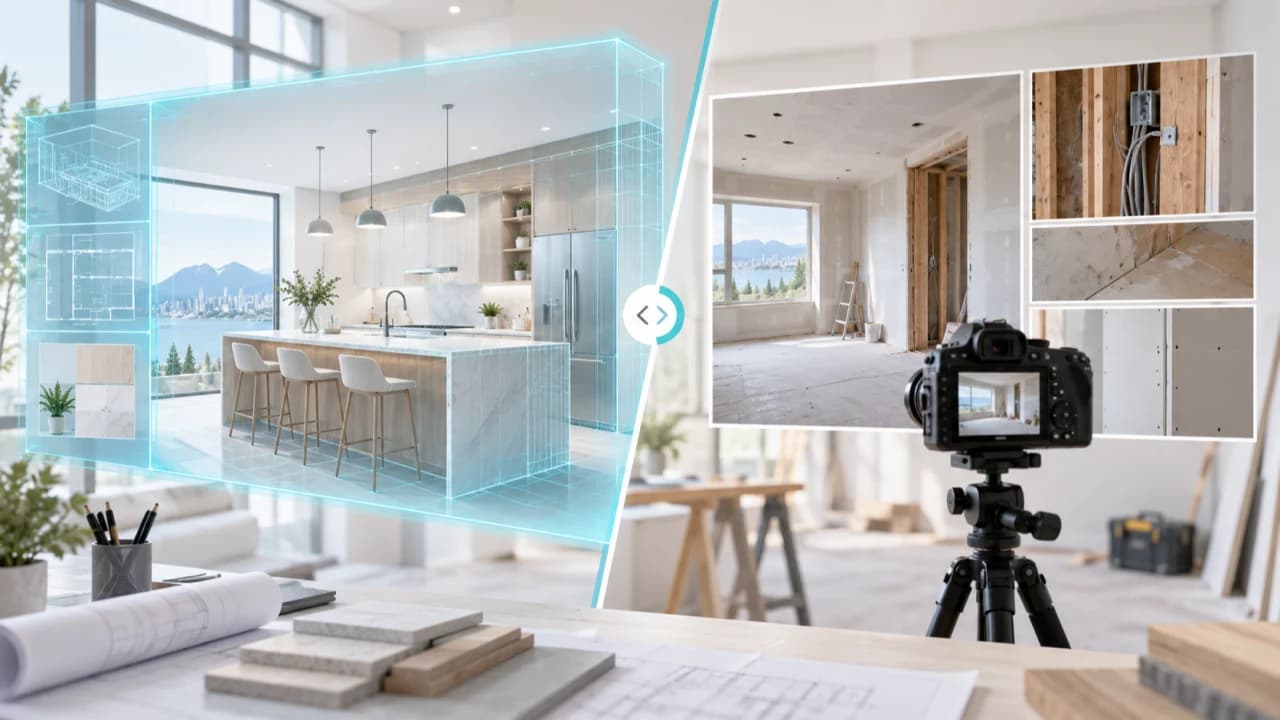
AI renovation concept video pitches an unbuilt space; real footage documents the site. What should Vancouver teams show?
Decide whether the viewer needs an idea or evidence
AI renovation concept video can help a Vancouver design-build team communicate a possible future space, but a generated clip cannot document what was actually built. A design presentation asks, "Could the room feel like this?" A project case study asks, "What did your team really deliver?" Put those questions on different pages of the brief before deciding what to generate or film. That distinction is more useful to a prospective client than a blanket argument that AI is good or bad.
A concept clip might explore two finishes for an unbuilt kitchen, test a camera path through an architect's proposed layout, or help stakeholders react to a general mood. It is a visual proposal, not a verified construction drawing, a permit-ready representation, or a substitute for a contractor's specification. Dimensions, structural details, materials and final availability must be checked by the project team against its actual plans and decisions. For a portfolio film, film the real finished room, approved occupants and installed details; a plausible generated countertop is still not proof that the countertop exists.
Before making either piece, write a one-sentence purpose and audience: private design review, fundraising pitch, public marketing, or documented completed work. Mark the status of every visual on a shot list. For real-world project storytelling, our Vancouver corporate video production service can scope interviews and on-site coverage; for explicitly illustrative sequences, see our AI video production service. The buyer should know which kind of video they are commissioning.
Build a labelled concept without borrowing credibility from a real site
Start a concept video with an approved design brief: intended use, room type, mood, broad materials, and any non-negotiable constraints the architect or owner has actually confirmed. Choose reference images that the client is authorized to provide. Keep source files separate from generated frames. Adobe's current Firefly image-to-video guide describes a workflow using an uploaded starting frame and, optionally, an end frame; its Generate Video FAQ tells users to have rights to uploaded images and warns that availability depends on geography, account type and other conditions. That is a tool example, not a promise that the output matches a future build.
Create a short visual test, then pause for human review. Ask whether a window, door, room connection or distinctive finish has appeared that no one approved. Keep a reference sheet that pairs each intended feature with its actual design document. Remove accidental site-specific details that may be read as a promise. If the proposed design changes during the project, update or retire the clip instead of letting an old simulation circulate as a current plan. Do not invent client homes, construction outcomes or a before-and-after montage to make a pitch more dramatic.
In the deliverable itself, label the sequence prominently as an illustrative AI-generated concept, identify the design status and name what is subject to change. Do not hide that information in a tiny end credit. If the clip will be used in a public ad or beside actual project photos, check the overall impression as well as individual captions. Canada's Competition Bureau guidance on misleading representations specifically discusses material claims, illustrations and the general impression of an ad. This is practical production guidance, not legal advice.
Document the built work with a separate evidence trail
A real renovation story begins before the result is visible. With the owner's permission, record a dated view of the actual room before work, approved in-progress stages and the completed space. Keep the original camera files, capture dates, site notes and the client's approved description of what changed. Record the same practical landmarks where possible: entry, window placement, room connection and key detail. If a wall disappears during demolition, you cannot recreate an authentic before frame afterward. The brief in our Vancouver renovation project video guide explains the three-stage shot plan in more depth.
Separate the purposes of the shoots. Progress footage for internal reporting may show private belongings, staff, supplier information or unfinished work that the client never agreed to make public. A case study needs permission for the location, identifiable people and the channels where it will run. Ask the owner who can approve publication, whether there are embargoes, and what the contractor can accurately claim about the project. A camera shows appearances; it does not certify structural quality, project cost, energy performance or compliance. Ask the relevant project professional to substantiate those statements before adding them to voiceover or captions.
Build a simple provenance sheet: file name, capture date, location or room, whether it is camera-original or generated, who approved it, and where it may appear. Use real footage for project outcomes, installed products, client comments and portfolio evidence. If a concept sequence appears in the same edit, interrupt the visual continuity with a clear on-screen cue and voiceover so the audience cannot mistake the simulation for the finished project. View our video portfolio to discuss presentation style, not as a claim that any example shown here depicts a particular renovation.
Review rights, composites and the handoff before publication
A combined production can be efficient when everyone knows which assets are allowed in which channel. At kickoff, list the source of each photo, render, plan and video clip, plus the people, products, logos, music and interiors visible. Confirm that the person supplying a photograph or drawing may authorize its use as a model input as well as in the final edit; ordinary access to a file is not the same as permission for every use. Check the selected provider's current terms, not a generic claim that all AI output is automatically cleared. Record the approved distribution channels, especially if the client later wants paid ads or a partner campaign.
For a composite, review a representative shot at delivery size and normal playback speed. Check frame-to-frame stability, room geometry, brand colours, product appearances, legible captions and audio. Compare it with the project team's signed-off plans and with original footage when the scene claims to show the site. If the generated shot drifts or inserts a nonexistent feature, either revise the concept, replace the shot with conventional graphics, or fall back to verified camera footage. No tool-specific feature guarantees a truthful marketing result; Adobe's own FAQ lists unintended objects and motion among known issues.
Name a single reviewer for design accuracy and another for publication rights if those duties sit with different people. Deliver the labelled concept, the dated real-site selects and the final marketing cut as distinct files; specify which versions may be forwarded externally. Archive the originals and approval notes. For a Vancouver design-build brief, contact Steven Video Production with the project status, approved reference assets, filming access and intended channels. We can discuss a scope for a concept proof, authentic site coverage or both without promising that a speculative image will be built exactly as shown.
Choose the deliverable that matches the buying decision
A client comparing design approaches may need a short labelled concept proof, a still mood board or a walk-through of approved drawings. A client evaluating a contractor's past work needs verifiable footage of that actual project, an accurate description of scope and permission to show it. If both are useful, quote them separately: concept development and review; site access and filming; editing and compositing; source-asset clearance; captions, cutdowns and approval. A software subscription alone does not cover those production tasks, and there is no universal fixed price for every renovation brief.
At proposal stage, ask five questions. What is the current project status? Which supplied assets are approved for generation? Which details must be factually exact? Who signs off design claims and public release? What happens if a generated test is not reliable enough to use? Agree on the number of proof rounds and a real-footage or graphics fallback before committing to an ad deadline. This avoids using attractive speculative frames as a substitute for site documentation merely because they were available sooner.
The final public edit should let a viewer distinguish an idea from evidence without reading an explanation elsewhere. If a family is choosing a renovation team, trust depends on knowing what already happened and what is still proposed. Send your intended audience, approved designs, site access and required outputs through our contact page; the right answer might be an AI concept, a documentary shoot, or a clearly labelled combination.
Frequently Asked Questions
Can an AI renovation concept video be used as a contractor portfolio example?
Not as evidence of a completed project. Label it as an illustrative proposal; use permission-cleared real footage and accurate project facts for completed-work examples.
Do we need permission to animate a client's renovation photos with AI?
Confirm that the person supplying the images can authorize their upload and intended use, check the tool's current terms, and clear people, property and third-party material before publication.
How should we label a generated renovation concept in a video?
Place a prominent on-screen illustrative-concept label on the relevant shots, state that details may change, and keep real built-work footage visually distinct.
Is a generated before-and-after renovation video acceptable?
A proposed after visual can illustrate a design if labelled; it must not imply that an unbuilt result is a real completed job. Use dated camera-original footage for claims about actual construction.
How much does an AI renovation concept video cost in Vancouver?
Price depends on approved assets, concept iterations, fact-checking, compositing, revisions and deliverables. Ask for a project-specific scope rather than treating a model subscription as the production budget.
Ready to start your project?
Get in touch for a free consultation. I typically respond within a few hours.