
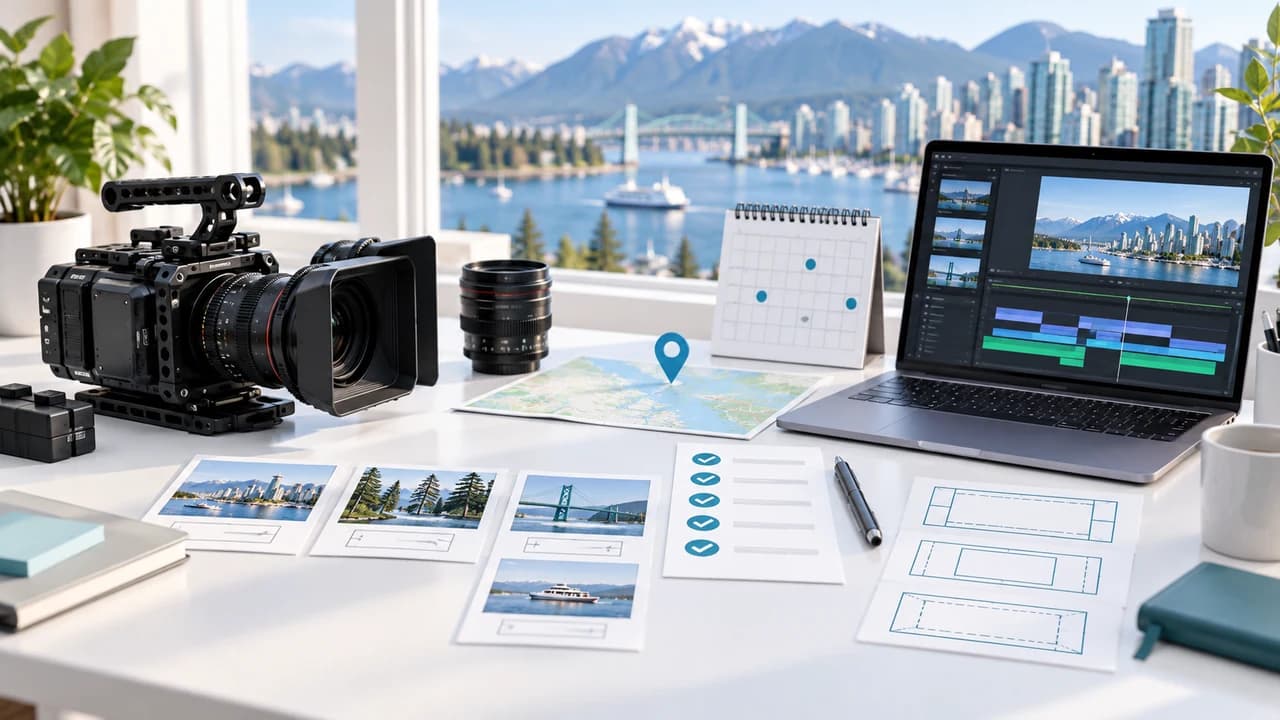
Hire a Vancouver videographer with a clear brief covering goals, locations, deliverables, usage and timing.
Start with the business goal, audience and one useful next action
Hire a Vancouver videographer after you can explain the business result the video should support. That does not mean arriving with a finished script or a complete shot list. It means identifying the problem clearly enough that a producer can recommend the right scope. Are you introducing a service, launching a product, documenting an event, recruiting employees, building trust through customer stories, or creating a library of social content? Each goal leads to a different production plan, so a request that only says “we need a video” cannot produce a dependable quote.
Name the primary audience and what that audience already knows. A homepage visitor who has never heard of the company needs different context from an existing customer watching a product update. Then choose one useful next action: book a consultation, visit a location, request a proposal, apply for a role, register for an event, or understand a process. A video can support several channels, but one central decision keeps the story focused.
Write down the core message in one or two sentences. Include any claims, product names, dates or legal wording that must be exact, and identify who will verify them. If the project needs English, Mandarin or Cantonese delivery, captions or interviews, include that at the start because language affects scripting, talent, interview time and review.
A good first paragraph for your inquiry might read: “We want a 60–90 second video for Vancouver business owners who are comparing providers. It should explain our process, show the team at work and lead viewers to request a consultation.” That is enough direction for a freelance videographer in Vancouver to ask useful follow-up questions without forcing you to design the production alone.
List locations, people and the realities of the shoot date
A quote becomes more accurate when the production team knows where and when filming may happen. List every possible location, its neighbourhood or city, whether it is indoors or outdoors, and who controls access. Mention parking, elevators, loading restrictions, security check-in, business hours, noise, customer traffic and any limited setup window. A quiet office interview and an active retail floor may be in the same building, but they require different audio, lighting and scheduling decisions.
For each person who may appear, note the role they play and whether they are confirmed. Distinguish between a spokesperson, interview participant, employee appearing in background footage, customer testimonial subject and professional talent. If someone has only a short window, state it. If minors, customers or members of the public could be recognizable, flag that early so the production can plan consent, framing or a controlled area rather than solving the issue after filming.
Provide the preferred shoot date, at least one backup date and the true publication deadline. Those are not always the same. A launch date may require time for editing, stakeholder review, captions and delivery testing. Outdoor scenes, aerial footage and travel can also make a backup plan important. Do not assume that the crew can simply move indoors and capture the same story; name the must-have shots and the acceptable alternatives.
Finally, describe what the location will look like on shoot day. Is a property staged, an office occupied, a product ready, signage current and equipment operational? If preparation depends on another vendor or internal team, include that dependency. The goal is not to make the project sound complicated. It is to expose schedule risks early, when the team can still design an efficient day and price the real work instead of adding contingency for unknowns.
Define the deliverables by platform, length and aspect ratio
“One video” is rarely a complete deliverable list. Before requesting a quote, identify where the finished work will appear and what each placement needs. A website brand film, LinkedIn post, Instagram Reel, YouTube pre-roll and event screen have different viewing contexts. They may require different lengths, openings, caption treatments and aspect ratios even when they use footage from the same shoot.
Create a simple deliverable table in your brief. For each item, list its purpose, platform, approximate duration, aspect ratio, language, caption requirement and deadline. For example: one 90-second 16:9 website film, three 20-second 9:16 social cutdowns, and one clean interview excerpt with burned-in English captions. If the exact number is not decided, give a likely range and ask the producer to price clear options. That is more useful than requesting “all raw footage plus a few versions” without defining how those assets will be used.
Ask whether horizontal and vertical versions need to be planned during filming. Cropping a finished widescreen frame does not always create a good vertical shot, especially when two people, product details or on-screen demonstrations must remain visible. A Vancouver video production service can build framing and shot coverage around the delivery list before cameras roll, which is usually more efficient than rebuilding the edit later.
Also clarify whether you need a master without music or captions, separate caption files, thumbnail images, audio-only extracts, short hooks, alternate calls to action, or versions without a date. Avoid ordering extras merely because they might be useful. Every output creates review, export and quality-control work. Choose the versions tied to a real publishing plan, then leave room to add a clearly priced option if the campaign expands.
Clarify usage, brand assets, references and factual boundaries
Your videographer needs to know how the finished material will be used. State whether the video is intended for your own website and organic social channels, paid advertising, broadcast, a conference, internal training, partner distribution or a campaign running in several regions. Usage can affect music, stock footage, talent agreements and the way source assets must be cleared. If the plan may expand later, say so before production rather than assuming every licence covers every future placement.
Collect the materials the team should review: current logos, brand colours, fonts, product imagery, presentation decks, approved claims, previous videos and any existing footage that might be reused. Identify the owner or source of each file. Sending a reference link communicates taste, not permission to copy it. Explain what you like about a reference—its interview tone, pace, lighting, camera movement, structure or sound—so the producer can understand the direction without imitating another brand. You can also review Steven Video Production’s video portfolio and point to a project quality or storytelling choice that fits your goal.
Separate facts from creative freedom. Make a short “must stay accurate” list for products, locations, uniforms, procedures, people, prices and claims. Then list what may be stylized, such as an abstract opening, motion graphics, colour direction or transitional imagery. This matters for both traditional post-production and AI-assisted work: a visually attractive change is not useful if it alters a detail that customers rely on.
Tell the producer what cannot appear. Confidential screens, customer information, unreleased packaging, restricted areas, competitor branding and unapproved employees are easier to avoid with a pre-shoot note. If your company has legal, compliance or accessibility requirements, provide the actual wording and the reviewer’s contact. The production team can manage image and sound, but your organization remains the authority on its own factual and regulatory statements.
Set the review path, turnaround needs and decision ownership
A realistic schedule includes more than the filming date. It may include discovery, a creative brief, scripting or interview questions, location planning, production, media backup, editing, music selection, graphics, captions, review rounds, final quality control and delivery. Tell the producer the immovable publication date and any internal milestones that lead to it. If an executive, legal reviewer or partner needs several days to respond, that time belongs in the schedule.
Name one person who will consolidate feedback and approve the final cut. Multiple stakeholders can review, but sending separate and conflicting notes slows the edit and makes scope difficult to control. Ask reviewers to comment with timecodes and distinguish factual corrections from preferences. “The product name at 00:24 is outdated” is actionable. “Make it more exciting” needs a discussion about pace, music, performance or visuals before it becomes an edit instruction.
State the number of review rounds you expect and what counts as a revision. Correcting an approved title is different from changing the audience or story after the first cut. If the organization has not agreed on its message, schedule that decision before production. Editing cannot efficiently resolve a strategy dispute that stakeholders postponed.
Turnaround should be described as a need, not assumed as a standard promise. A short event recap, a multilingual interview film and a campaign with motion graphics have different post-production paths. Ask for a proposed timeline based on the confirmed scope. If fast delivery is essential, identify which version is needed first and which elements can follow. A focused first deliverable may be more reliable than rushing every cutdown, caption file and format at once.
Send a quote request that makes scope, options and next steps clear
Your final request does not need to be long, but it should be complete enough for a productive estimate. Include the business goal, audience, central message, desired action, locations, preferred and backup dates, people on camera, deliverable list, platforms, languages, usage, existing assets, references, deadline, reviewers and known restrictions. Attach only the most relevant files and label links so the recipient knows what each one demonstrates.
If you have a budget range, share it together with the result you need. A range is useful because the producer can prioritize the elements that affect the outcome and offer alternatives. If you do not have a range, ask for a recommended scope plus clearly separated options. For example, the base option might cover one location and one master film, while alternatives show the cost of a second location, vertical cutdowns, an additional language or faster turnaround. This produces a decision you can compare rather than a single number with hidden assumptions.
When quotes arrive, check what is included: planning, crew, equipment, travel, production hours, editing, graphics, music, captions, review rounds, versions, delivery method, taxes and any optional costs. Compare scope and responsibility, not only the total. The lowest price is not a saving if it omits the outputs or preparation required for the campaign. Ask what information could change the estimate and when the date becomes reserved.
Use this copyable closing line: “Please recommend a scope for the goal above, identify any assumptions, and separate essential work from optional deliverables.” Then contact Steven Video Production with your brief, preferred date and location. A clear checklist does not lock you into a rigid production. It gives the videographer enough context to propose a simpler, more accurate and more useful plan.
Frequently Asked Questions
What information should I send before hiring a Vancouver videographer?
Send the goal, audience, location, preferred and backup dates, people on camera, deliverables, platforms, languages, usage, deadline, references and approval contact. Add any access, privacy or brand restrictions that could affect filming.
How far in advance should I book a Vancouver videographer?
Book as soon as the shoot window and decision-maker are known. The right lead time depends on planning, location access, crew, talent, weather and post-production. Share the publication deadline so the producer can work backward and confirm feasibility.
Do I need a finished script before requesting a video quote?
No. A clear goal, audience and message are enough to begin. Tell the producer whether you expect scripting, interview development or a client-supplied script, because each option changes the work included in the quote.
Should vertical social videos be included in the original quote?
Yes, if you know you will use them. Vertical framing may need different composition and coverage during the shoot. Defining the number, length and platform early is more efficient than asking for unspecified cutdowns after editing.
What should I compare in Vancouver videographer quotes?
Compare planning, crew, hours, locations, equipment, travel, edit scope, music, captions, revisions, deliverables, usage assumptions and delivery schedule. A lower total may cover less work, so compare the responsibilities and outputs line by line.
Can I ask for a quote without knowing my exact video budget?
Yes. Ask for a recommended base scope and separately priced options. If you do have a realistic range, sharing it helps the producer prioritize what will most improve the business result without adding low-value extras.
Ready to start your project?
Get in touch for a free consultation. I typically respond within a few hours.