
Vancouver construction progress drone video brief: plan repeatable angles, milestone dates and useful handoffs.
Start a Vancouver construction progress drone video brief with its audience
A Vancouver construction progress drone video brief should say what each return visit must prove to the viewer, not just ask for another impressive flyover. An owner may need an internal visual update; a design-build firm may want permission-cleared progress footage for a future case study; a consultant may simply need context for a meeting. None of these uses makes an aerial marketing edit a certified inspection, survey, measurement or compliance record. Decide which purpose applies before a crew plans camera positions or edits a sequence.
Give the producer the project address, approximate site boundary, current stage, anticipated milestone windows, on-site contact and who may approve filming. Mark adjacent homes, sensitive activities, confidential drawings and any workers or visitors who must not appear. Say whether the approved audience is an internal project team, stakeholders, a client presentation or a public campaign. Footage that is suitable for one audience is not automatically cleared for another.
Ask for a simple baseline package: an establishing view showing context, a small set of repeatable positions, a ground view for details that the aerial cannot show, and a date-labelled folder of selected files. If the point is to tell a client's story rather than to inspect construction, Vancouver drone videography can be planned together with ground coverage. The first visit should create a usable reference for every later visit, not an isolated highlight reel.
Choose milestones that change the picture, not just the calendar
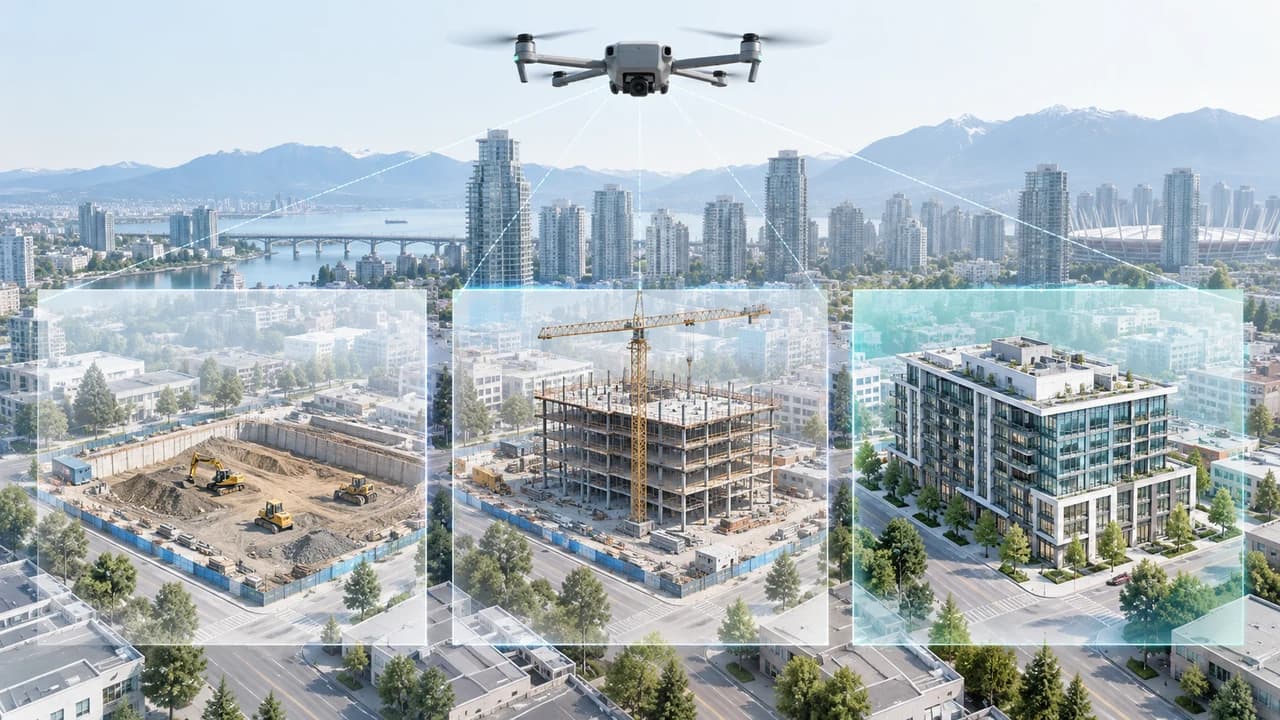
A fixed monthly appointment is convenient, but a visually meaningful milestone is often more useful than a date alone. With the site lead, identify windows such as pre-construction context, excavation or foundation, visible structure, enclosure, exterior finish and a cleared final site. These are illustrative stages, not a promise that every project follows the same sequence. Ask which work may be concealed quickly and which stage will show progress clearly from a permitted vantage point. Confirm safe access with the site's own supervisor before each visit.
Make a two-column brief for every requested pass: what has changed since the last visit, and what the audience should recognize. At structure, show the emerging footprint and neighbouring context. At enclosure, show visible changes to the outer form without claiming what a wall contains. At final completion, add a ground-level view that actually shows the finished entrance or public-facing space. Do not ask a pilot to fly over active workers just because the shot would look dramatic. A safe ground image is better than an unapproved aerial angle.
If the owner also wants a marketing film, plan short interviews or ground details around the same milestones. Our corporate video production work can help organize a project story from approved footage; the contractor remains responsible for its own technical records and factual sign-off. Agree in advance whether missed dates trigger a replacement visit, a ground-only pass or a reworked edit, rather than implying an aerial shoot is guaranteed regardless of site conditions.
Write a repeatable shot card for each safe flight position
Repeatability makes a progress series understandable. On the first approved shoot, note a reference image, camera direction, approximate height, lens or field of view, framing landmarks and whether a slow lateral move is possible. Record these as planning references rather than fixed flight instructions: the pilot must reassess airspace, obstacles, people and equipment each visit. A crane, hoarding wall or new structure can make yesterday's angle inappropriate. Never ask a pilot to match a past shot by ignoring a changed site.
Pick a few anchors that will stay visible across stages: a nearby street corner, a roofline, a site boundary or a fixed ground marker supplied by the project team. Keep a wide context shot and one or two closer views of actual work, but avoid presenting an aerial still as a measurement. Note the time of day and prevailing light so an editor can compare material without suggesting progress that comes from radically different shadows. If an angle cannot be repeated safely, label the replacement rather than hiding the change in a before-and-after transition.
For each visit, request filenames or a manifest with capture date, milestone, vantage identifier and approval status. Distinguish selected visuals from any separate contractor documentation. This small discipline helps the owner find a defensible comparison later and gives an editor a coherent series. If the project calls for a public-facing case study, look at video portfolio examples to discuss storytelling, while keeping technical construction evidence in the proper project systems.
Clear the airspace and the construction site before promising footage
A project address does not establish permission to launch. Transport Canada's where-to-fly guidance says a pilot should identify airspace, nearby aerodromes and current NOTAMs before operating. For controlled airspace it specifies at least an Advanced pilot certificate, an appropriately declared drone and authorization from the air navigation service provider. NAV CANADA's flight-planning page describes NAV Drone as a way to plan flights and request permission in airspace under NAV CANADA's control. A Basic certificate alone is not blanket permission for controlled airspace; a project should be scoped according to the actual pilot, aircraft, location and applicable authorization.
Airspace approval is not the same as permission to enter and film an active job site. Ask the site lead for access windows, induction requirements, personal protective equipment, hazard zones and a way to pause filming when machinery or people move into the plan. Transport Canada also directs pilots to survey obstacles and respect privacy and trespass laws in its safety guidance. Decide who handles worker appearances and neighbouring property in the frame before publishing anything. A reference angle can be moved or omitted if those checks fail.
A buyer should request a conditional aerial plan plus a ground-only alternative, not a guarantee. Have the pilot confirm the operation category, site-specific airspace, permissions and weather at each visit. Do not assume that an authorization from one milestone automatically covers the next. If no safe, authorized flight is available, ground footage, owner-supplied approved photos or a rescheduled pass can still serve the communications brief.
Specify files, review and a realistic handoff for every visit
Before the first filming date, decide whether you need selected stills, short clean clips, a dated progress edit, a vertical social cut or a final before-and-after sequence. These are different deliverables. Write the intended audiences and distribution channels beside each item so the editor knows whether to include titles, captions and branding. Decide who will confirm dates, stage names and any factual claims before an owner update or public post goes live. Do not add construction percentages or engineering conclusions based only on what the camera sees.
Request a folder structure that a new team member can understand: project, date, milestone, angle ID, approved selects and final export. Agree on the review link, one responsible approver, feedback window and what happens if a milestone is delayed. A side-by-side cut should label different capture dates and, where framing changed, avoid a deceptive match. Keep files containing identifiable people or private neighbouring property out of the public edit until the relevant permissions and review are complete.
When requesting a quote, send the address, expected stages, approximate number of visits, required files and intended publication channels; ask what is excluded and how reschedules work. A recurring series needs a consistent brief more than a flashy one-off flight. For a site-specific filming proposal, contact Steven Video Production with the location, site lead, timeline and the comparison shots you want. We can discuss an aerial-plus-ground plan subject to the actual access and flight checks, not promise that every requested angle can be flown.
Frequently Asked Questions
What should a Vancouver construction progress drone video brief include?
Include the project address, site contact, intended audience, milestone windows, repeatable reference angles, access restrictions, approvals and the selected files or edits needed after each visit.
How often should a construction site be filmed by drone?
Choose visually meaningful milestones with the site lead, then consider regular intervals only if they serve the reporting need. Each visit still depends on access, conditions and authorization.
Can the same flight plan be reused at every construction milestone?
Use past framing as a reference, not an automatic flight permission. The pilot must reassess airspace, NOTAMs, obstacles, people, equipment and site access for each visit.
Does progress drone footage replace a construction inspection or survey?
No. Aerial visuals can support communication, but technical inspections, measurements and compliance records remain the responsibility of the qualified project team.
What if the planned Vancouver site cannot be flown?
Ask for a ground-only capture, a different authorized position or a rescheduled milestone. Do not promise aerial footage before the actual pilot and site-specific checks are complete.
Ready to start your project?
Get in touch for a free consultation. I typically respond within a few hours.