
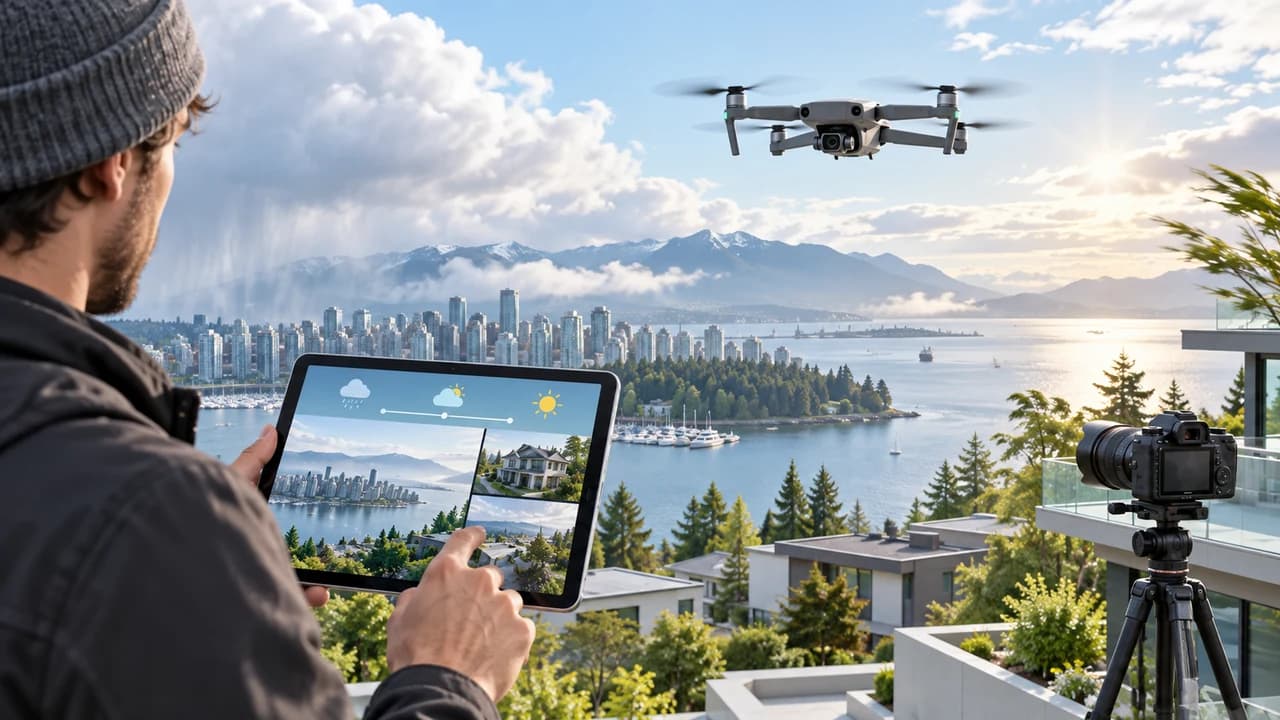
Drone videography Vancouver weather planning helps clients prepare for wind, rain, light and backup shots.
Why drone videography Vancouver weather planning starts before shoot day
Drone videography Vancouver weather planning is not simply checking whether a rain icon appears in an app. A useful plan connects the story you need, the location, the available light, the aircraft and camera requirements, the operating environment, and a safe fallback that still produces valuable footage. Vancouver conditions can change across neighbourhoods and through the day, so a forecast is an input to a production decision rather than a guarantee that a flight will happen.
Start by identifying why the aerial view matters. Is it needed to establish a building near the waterfront, explain access to a commercial site, reveal the scale of a property, or provide an opening shot for a brand film? A shot that carries essential information deserves more scheduling flexibility than a decorative transition. Tell the producer which aerial images are must-haves, which are preferences, and which can be replaced by elevated or ground-level coverage. This distinction makes the quote and contingency plan more accurate.
The person responsible for the flight must make the final go or no-go decision using current conditions, the site, applicable requirements, and the planned operation. A client should not be asked to judge flight safety from a consumer weather app. The client's role is to share location information, schedule constraints and creative priorities early enough for the operator to assess them. Our Vancouver drone videography service can scope aerial coverage as part of a wider production rather than treating the drone as an automatic add-on.
When requesting a quote, provide the exact address or site boundary, preferred date and time window, publication deadline, intended shots, access contact, and at least one acceptable alternative. If the aerial view is central to the campaign, say whether a backup date is possible. If the deadline matters more than the aerial shot, authorize a ground-based substitute in advance. That one decision prevents uncertain weather from placing the entire production on hold.
How wind affects more than whether a drone can take off
Wind changes flight decisions, image quality and the time required to capture a controlled move. Conditions at roof height or over an exposed shoreline may differ from what people feel beside a sheltered entrance. Buildings, trees and terrain can also create gusts or turbulence around a site. For that reason, a calm experience at street level does not by itself confirm that a planned aerial move is suitable. The operator needs to assess the actual launch area, flight path, surrounding obstacles and current conditions.
Creative direction matters too. A wide establishing shot may tolerate different movement than a precise reveal close to architecture. Trees, flags, water and loose objects can make wind visible even when the aircraft footage remains stable. That may be useful if the story is about weather or an active waterfront, but distracting if the goal is a calm luxury-property presentation. Strong movement in the environment can also make edits between aerial and interior footage feel inconsistent.
Clients can help by marking the priority order of shots. Ask for the essential establishing view first, then secondary angles, then optional beauty shots. If conditions are suitable only during part of the production window, the team can capture the highest-value material before moving to interviews, interiors or ground-camera work. Avoid building a schedule that assumes the drone can launch at any moment between other activities; setup, site checks and coordination require their own time.
A backup shot list should describe the information each aerial shot was meant to communicate. If the drone was supposed to show proximity to a road, waterfront or neighbourhood landmark, a carefully selected ground view, interior view toward the landmark, licensed map graphic, or existing approved footage may preserve that message. The substitute should not pretend to be the same image. It should solve the same communication problem honestly, using material that can be cleared and integrated into the edit.
Rain, moisture and visibility: deciding what can continue
Rain affects more than the aircraft. It changes visibility, contrast, reflections, wardrobe, location access, equipment handling and the continuity between shots. Light rain at one location may appear as haze against distant buildings, while wet pavement can create attractive reflections for ground footage. A weather-aware plan separates the parts of the production that truly depend on aerial conditions from the work that can continue indoors or at street level.
Do not assume that a brief pause in rain creates an immediate flight window. The operator still needs to assess the site and current conditions, and the creative team must consider whether the view supports the intended story. Low cloud, mist or reduced distance visibility may hide mountains, skyline features or a property's context. Conversely, a clearing sky after rain can provide clean colour and reflective surfaces if the schedule has enough flexibility. The decision is about safety and useful imagery together, not merely whether precipitation has stopped.
For real estate work, prepare the interior and ground exterior plan so filming can proceed even if aerial coverage changes. The Vancouver real estate video service can coordinate property flow, detail shots, agent segments and exterior alternatives in one brief. Keep entrances clear, confirm indoor access, and identify covered positions that can show the building without exposing equipment to unnecessary moisture. If the drone portion is removed, know whether the final film should become shorter, use a different opening, or reserve space for aerial footage captured later.
Continuity should be discussed before splitting coverage across dates. A bright aerial sequence captured later may not naturally match a rainy ground sequence from the original day. Sometimes the contrast can be designed into the edit; sometimes it weakens credibility. Ask the producer whether a backup date applies only to aerial shots or to the weather-dependent exterior sequence as a whole. That decision affects scheduling, crew time, editing and the final look, so it belongs in the quote rather than being improvised after the first shoot.
Plan for usable light, not just a clear sky
Clear weather does not automatically produce the best aerial image. Midday sun can create hard shadows, bright reflections and strong contrast between building faces. Overcast conditions can provide softer, more even light, although the sky and distant background may appear less dimensional. Early or late light may add shape and warmth, but the useful window can be short and may interact with site access, neighbouring buildings, traffic and the direction a property faces.
Share the visual priority before the date is selected. If the video must show a west-facing view, exterior architecture, mountain context or illuminated signage, the producer can consider sun direction and the site's obstructions when proposing a window. Reference images are helpful when they identify a quality such as soft light, long shadows or a clear skyline. They should not be treated as promises that Vancouver weather, seasonal sun and the location will reproduce another production exactly.
Match aerial timing to the rest of the shoot. An interview may need a quiet indoor period, a storefront may be busiest at a particular hour, and a property may look best after rooms are prepared. The drone segment should fit those realities instead of forcing every scene around one speculative weather window. For a broader campaign, review examples in our video production portfolio and explain whether the aerial material should feel polished and architectural, energetic and urban, or natural and documentary. That direction helps determine which conditions are useful rather than merely acceptable.
Also decide what happens when the light is safe and clear but creatively wrong. The choices may include adjusting the shot direction, emphasizing detail over skyline, capturing neutral documentation, moving selected exterior work to a backup window, or proceeding without aerial footage. There is no universal answer. The right option depends on how central the shot is, the publication deadline, access and budget. Put those priorities in order before shoot day so the producer can make a recommendation without waiting for a new approval chain.
Build a backup shot list that protects the business goal
A strong backup plan is not a list that says film something else. It maps every high-value aerial idea to a practical alternative. Create three columns in the brief: intended aerial shot, message it communicates, and approved fallback. An orbit around a facility may communicate scale; the fallback might combine a wide ground angle, operational details and a simple location graphic. A rise over a property may reveal the surrounding neighbourhood; the fallback might use an elevated interior view, street approach and clearly licensed map imagery.
Prioritize substitutes that can be captured with the crew and access already booked. Ground-camera exterior shots, gimbal movement, long-lens context, interior views through windows, signage, arrival sequences and close operational details can often maintain production value. A taller camera position may help at some sites, but it still requires safe, authorized access and should not be assumed. Existing footage can be useful only when its ownership, date, resolution and relevance are confirmed. Do not insert generic stock that could misrepresent the real location.
The edit should acknowledge the material that exists rather than imitate a missing drone sequence. A good producer can restructure the opening, shift narration, shorten a transition or use sound to preserve momentum. If a future aerial pickup is approved, define where it belongs and whether the project can wait. If the campaign must launch immediately, approve an aerial-free master that stands on its own rather than leaving an obvious placeholder.
Write down who can authorize the fallback on the day. If every change must travel through several stakeholders, the crew may lose the useful window while waiting. One reachable decision-maker should understand the creative priorities, deadline and budget boundary. Before production, ask them to approve the fallback logic, not every possible frame. This gives the team enough freedom to respond to conditions while protecting brand accuracy and avoiding unplanned scope.
What to send before requesting a Vancouver drone videography quote
A useful quote needs more than a date and the word drone. Send the exact location, site boundaries, preferred and backup windows, publication deadline, project goal, target audience, expected deliverables and where the finished video will be used. Describe the aerial shots in plain language and rank them as essential, preferred or optional. Include any known access instructions, property contacts, active operations, privacy concerns, neighbouring activity, construction, reflective surfaces or other conditions the producer should investigate.
Add the wider production scope. Is the drone supporting a property film, corporate story, tourism piece, construction update or event recap? Will the same team capture ground footage, interviews or vertical social clips? What aspect ratios and approximate lengths are required? A combined shot plan can prevent duplication and help the team capture transitions between aerial and ground perspectives. It also makes the weather fallback useful because the alternative footage is designed for the same edit.
Ask the quote to state its assumptions: included locations and production time, aerial and ground deliverables, travel, editing, music or graphics, review rounds, backup-date treatment, and what happens if the responsible operator decides not to fly. Do not assume that a weather hold, reschedule or later pickup is automatically included. A transparent scope should explain the decision path without promising a flight before the site and conditions are assessed.
Finally, decide your priority triangle: visual ideal, fixed deadline or fixed scope. Many projects can protect two more easily than all three when weather changes. If the aerial image is essential, keep timing flexible. If the launch date is fixed, approve a strong no-drone version. If scope is fixed, rank shots so the team spends available time on the most valuable evidence. To plan around your actual location, contact Steven Video Production with the address, date range, shot purpose and fallback preference. That information is enough to begin a weather-aware production plan without pretending the forecast can be guaranteed.
Frequently Asked Questions
Can drone videography continue in light rain in Vancouver?
The responsible operator must decide from the aircraft, site, current conditions and planned operation. Clients should not assume that light rain is automatically acceptable. Build an indoor or ground-camera plan so useful production can continue when aerial footage is not appropriate.
How windy is too windy for a Vancouver drone video shoot?
There is no client-facing number that applies to every aircraft, site and shot. Wind can differ above street level and around buildings. The operator assesses current conditions, flight path and equipment, then makes the final go or no-go decision.
Does cloudy weather make drone footage look bad?
Not necessarily. Overcast light can be soft and even, while clear midday light can create hard shadows and reflections. The useful condition depends on the location, view direction and visual goal, not simply whether the sky is blue.
Should I book a backup date for drone videography in Vancouver?
Book or discuss a backup window when the aerial view is essential and the schedule permits it. If the deadline matters more, approve an aerial-free fallback that can launch on time. The quote should explain how rescheduling or a later pickup is handled.
What can replace drone footage when weather changes?
Useful alternatives include ground-camera wides, gimbal approaches, long-lens context, interior views, signage, operational details, and properly licensed map or existing footage. Choose the substitute according to the message the aerial shot was meant to communicate.
What information is needed for a drone videography Vancouver quote?
Send the exact location, date options, deadline, shot purpose, priority views, site access, deliverables, usage, wider production needs and fallback preference. That gives the producer enough context to assess scope and propose a weather-aware plan.
Ready to start your project?
Get in touch for a free consultation. I typically respond within a few hours.