
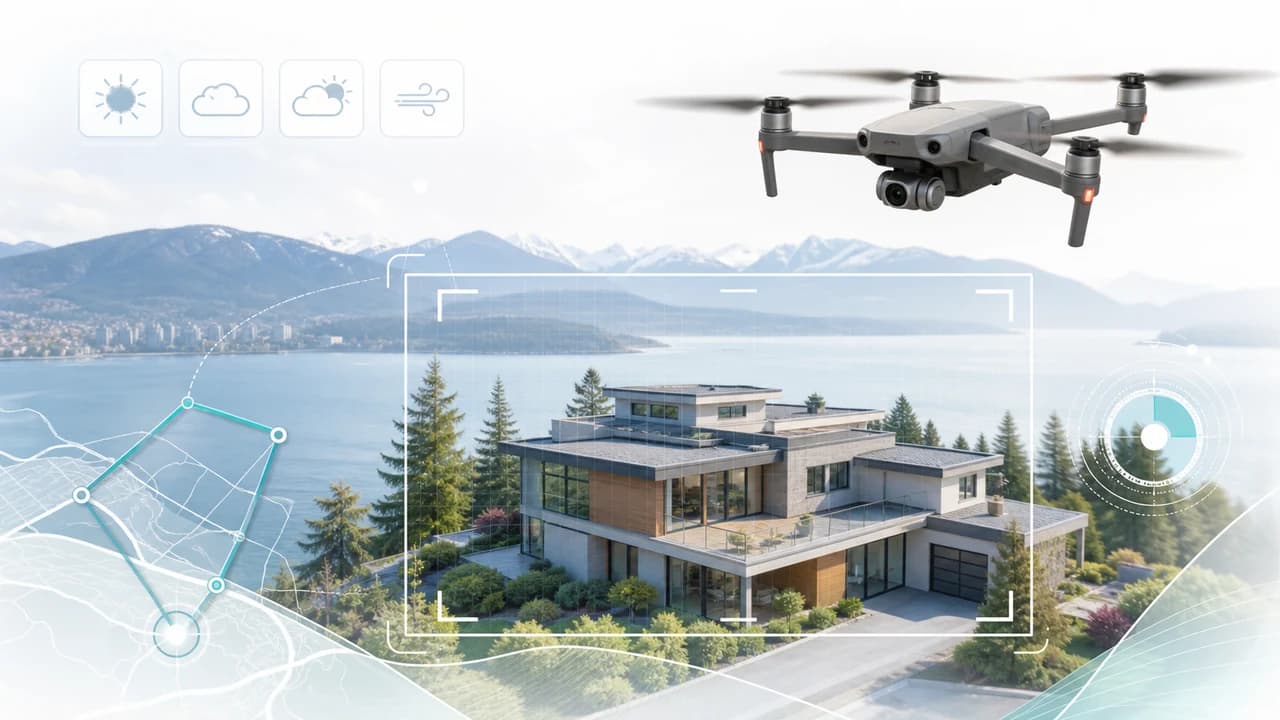
Before booking drone videography in Vancouver or Richmond, understand Transport Canada licensing, airspace restrictions, pricing ranges, and what aerial footage actually does for real estate listings.
What You Need to Know Before Booking Drone Video in Vancouver
Drone videography in Vancouver is a genuinely useful tool for real estate listings, corporate property showcases, event coverage, and environmental or construction documentation. It is also one of the most misunderstood services in terms of what is actually legal, where drones can fly, and what professional operators bring to a project beyond just owning a camera that goes up.
For clients in Vancouver, Richmond, Burnaby, Surrey, and the surrounding Metro area, the first thing to understand is that not all drone operators are legally equivalent. Transport Canada regulates recreational and commercial drone operations under the Canadian Aviation Regulations Part IX (RPAS). A videographer flying commercially without the correct certification and registration is operating illegally, and the footage from that flight has no professional standing — and in some cases can create liability for the client who hired them.
The second thing to understand is airspace. Greater Vancouver has some of the most complex drone airspace in Canada because of YVR, the North Shore airports, Vancouver Harbour, and downtown building density. Where a drone can legally and safely fly in Richmond is different from where it can fly in North Vancouver, Burnaby, or along the Fraser River. A professional operator knows these restrictions and works within them. An amateur who does not check the airspace is not saving you money — they are creating risk.
This guide covers what the law requires, where drones can fly in the Vancouver area, what drone videography actually costs from a licensed professional, and where aerial footage adds the most value for real estate and commercial projects.
Transport Canada Drone Licensing and RPAS Rules in BC
In Canada, commercial drone operations fall under Transport Canada's Remotely Piloted Aircraft System (RPAS) regulations. There are two certification categories relevant to most Vancouver commercial shoots: Basic Operations and Advanced Operations.
A Basic Operations certificate allows a pilot to fly in uncontrolled airspace (Class G) during daylight, keeping the drone within visual line-of-sight and over 30 metres from uninvolved bystanders. This covers a significant number of suburban and rural property shoots — detached homes with open yards, industrial sites, agricultural land, and non-urban commercial properties where the airspace is clear and people are not nearby.
An Advanced Operations certificate is required to fly in controlled airspace (Classes A, B, C, D, and E), within 30 metres of bystanders, over populated areas, or near aerodromes. For Vancouver and Richmond, this means almost any residential neighbourhood, any property near YVR's control zone, anywhere in downtown Vancouver, or any event with people present. The advanced certificate requires a formal flight review with an aviation examiner and marks a significant competency difference from the basic certificate.
Drones must also be registered with Transport Canada and carry valid registration marks on the airframe. Operators flying commercially without valid certification and registration can face fines up to CAD 25,000. When hiring a drone videographer in Vancouver, always ask to see their Transport Canada pilot certificate and drone registration number before the shoot. A legitimate professional will have these ready without hesitation.
Vancouver Airspace: Where Drones Can and Cannot Fly
The Greater Vancouver and Fraser Valley area has layered airspace restrictions that make drone operations considerably more complex than in most Canadian cities. Understanding the map before you plan a shoot saves time and prevents last-minute cancellations.
YVR and Richmond controlled airspace: Vancouver International Airport generates a large controlled airspace zone that covers much of Richmond and parts of Delta and Vancouver. Flying within YVR's control zone without specific flight authorization (via the NAV CANADA Digital Clearance System) is illegal regardless of altitude. Most of Richmond's residential areas fall inside or close to this zone. A licensed advanced operator can apply for specific corridor authorizations, but these require planning time — typically two to seven business days — and are not guaranteed. If your Richmond property needs aerial footage, book well in advance and confirm your operator has the authorization process in place.
Downtown Vancouver and urban density: The dense building environment in downtown Vancouver, False Creek, and adjacent residential neighbourhoods creates both physical and regulatory complexity. Many urban blocks fall within controlled airspace, and even where the airspace is technically uncontrolled, flying over populated areas requires an advanced certificate. This does not mean downtown aerial footage is impossible, but it requires a properly certified operator and may involve more planning and authorization paperwork than a suburban shoot.
North Shore airports: Boundary Bay Airport, Pitt Meadows Airport, and Vancouver Harbour Flight Centre all generate controlled airspace zones that affect drone operations in North Vancouver, Coquitlam, and surrounding areas.
Weather considerations: Vancouver's weather — rain, low cloud, marine layer, and high winds — limits safe drone operation for more days per year than most clients expect. A professional operator will have weather minimums below which they will not fly, and a good contract includes a weather cancellation and reschedule clause. Coastal fog and overcast conditions are particularly common from October through March.
Drone Videography Pricing in Vancouver and Richmond
Professional drone videography pricing in Vancouver and Richmond varies based on airspace complexity, shoot scope, authorization requirements, and deliverable type. Here are realistic ranges for 2026.
Add-on to a ground shoot (most common): When drone footage is added to a standard real estate or corporate video shoot, expect an additional CAD 300–600 for a half-hour to one-hour drone session, including basic editing of the aerial clips into the final deliverable. This is the most efficient format — the aerial component complements the interior and ground-level footage without becoming a separate production day.
Standalone drone shoot (residential real estate): A dedicated aerial session for a single residential property in an unrestricted airspace area typically runs CAD 500–900, including flight time, basic editing, and delivery of stills and video files. Richmond and areas near YVR may be higher due to authorization requirements and planning time.
Commercial or multi-location drone shoot: Corporate property showcases, construction documentation, event aerial, or large-scale real estate projects with multiple locations run CAD 1,200–3,000+ depending on day length, authorization complexity, crew requirements, and deliverable scope.
Flight authorizations in controlled airspace (YVR zone) may add cost and always add planning lead time. Some operators build this into their standard rate for the area; others charge separately. Clarify this before booking.
For real estate listings in Vancouver and Richmond, the practical question is whether aerial footage justifies the addition to the budget. For detached homes over CAD 1.5 million with meaningful lot size, rooftop terraces, pool access, or distinctive lot position, aerial footage typically returns the investment by differentiating the listing in a competitive market. For condos, townhomes, or properties where the surrounding context does not add value, ground-level video may serve the listing better.
Best Uses for Drone Video: Real Estate, Events, and Commercial Projects
Aerial footage adds the most value when it shows something that cannot be communicated from ground level. For Vancouver and Richmond real estate, that typically means three things: lot size and position, neighbourhood context and proximity to key features, and exterior architectural scale.
For a Richmond property, aerial footage can show the Fraser River waterfront proximity, the Steveston Village access, the distance to school catchments, and the lot's relationship to neighbouring properties — context that a street-level shot simply cannot provide. For a North Vancouver property, aerial footage can show the mountain backdrop, the accessibility to trails, and the property's position in the neighbourhood. These contextual signals are important to buyers who are often browsing listings from out of the area.
For corporate real estate — office parks, industrial facilities, development sites, agricultural property — aerial footage is often the primary way to communicate scale and context to investors and buyers. A drone-level view of a ten-acre development site in Surrey or a commercial waterfront property in Port Moody communicates in ten seconds what written descriptions cannot.
For events, drone footage of the exterior arrival, crowd scale, and venue context adds a production value layer to corporate event videos and conference recaps. For a gala at the Vancouver Convention Centre, aerial footage of the waterfront setting becomes the opening shot that establishes the event's quality before the interior footage begins.
For construction and environmental documentation, periodic drone photography and video provides a time-lapse record of site progress that is useful for investor updates, permit applications, and project marketing.
When drone footage is part of your planned shoot, discuss it during pre-production with the same detail as ground-level content: what shots are essential, what airspace restrictions apply, what the weather backup plan is, and what format the deliverables need to be for MLS, social media, and the client website. For questions about a specific property or project in Vancouver, Richmond, or surrounding areas, contact Steven Video Production or see the drone videography service page.
Frequently Asked Questions
Is drone videography legal in Vancouver for commercial use?
Yes, with the correct Transport Canada certification and drone registration. Commercial drone operators in Vancouver need either a Basic or Advanced RPAS certificate depending on the airspace and proximity to people. Always ask to see an operator's Transport Canada certificate and drone registration before booking.
What licence does a drone operator need for Vancouver real estate shoots?
For most residential areas in Vancouver, Burnaby, and Coquitlam (which often involve controlled airspace or proximity to people), an Advanced Operations certificate is required. For suburban or rural properties in fully uncontrolled airspace with no bystanders nearby, a Basic Operations certificate may be sufficient. Richmond properties near YVR typically require Advanced certification plus a specific flight authorization.
Can drones fly near YVR airport in Richmond?
With the right authorization, yes. YVR generates a large controlled airspace zone covering much of Richmond. An Advanced-certified operator can apply for a specific flight authorization through the NAV CANADA Digital Clearance System, which typically takes two to seven business days. Plan drone shoots in Richmond at least a week in advance to allow time for authorization processing.
How much does drone videography cost in Vancouver?
Drone footage added to a ground shoot typically runs CAD 300–600 extra. A standalone residential real estate drone shoot runs CAD 500–900. Commercial or multi-location drone projects run CAD 1,200–3,000+. Richmond and areas near YVR may cost more due to authorization requirements.
What is the best use of drone video for real estate listings?
Drone footage adds the most value for properties where context matters: lots with meaningful size or distinctive position, properties near water, mountains, or key neighbourhood features, and high-value listings where differentiation in a competitive market justifies the addition. For condos and properties where aerial context does not add information, ground-level video may serve the listing better.
Can drone footage be shot in winter in Vancouver?
Yes, but weather is a significant limiting factor. Rain, low cloud, marine layer, and high winds make more days unflable in Metro Vancouver than in most Canadian cities. A professional operator will have weather minimums and should include a weather cancellation and reschedule clause in their contract. November through March has the highest frequency of weather-related cancellations.
Ready to start your project?
Get in touch for a free consultation. I typically respond within a few hours.