
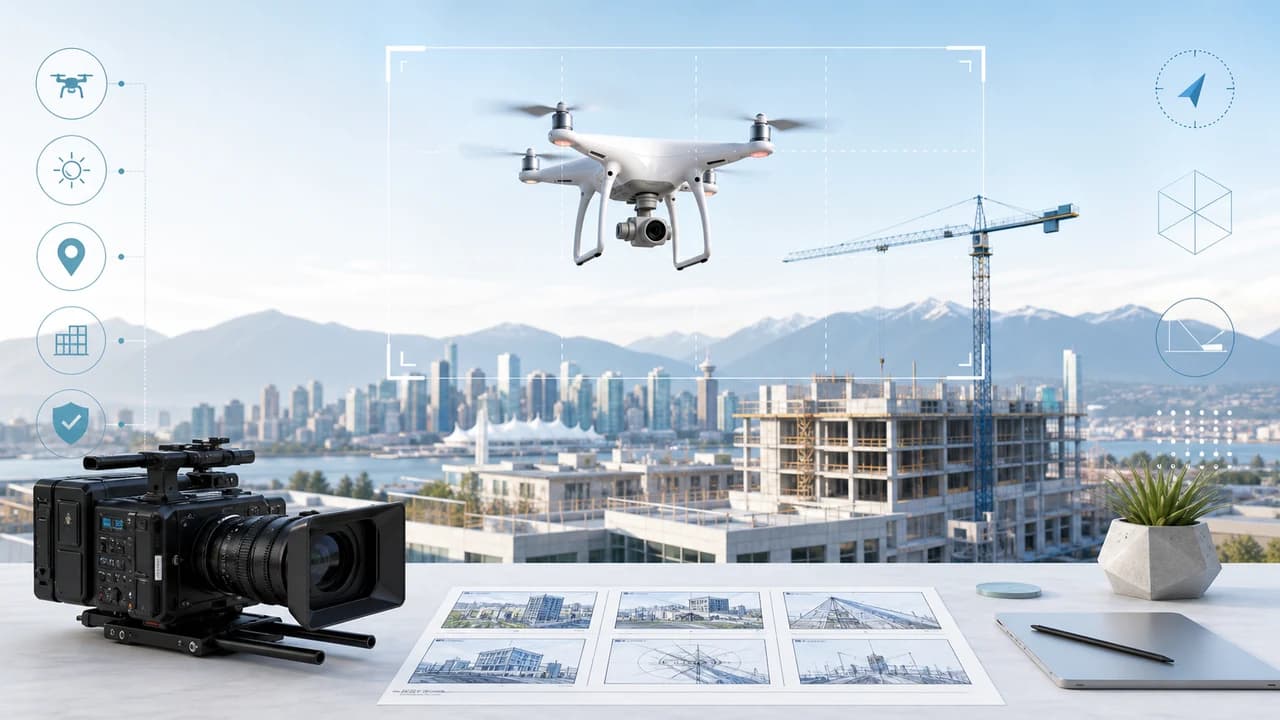
Drone videography Vancouver projects run more smoothly when location, story, access, timing, and deliverables are planned before filming.
Drone videography Vancouver starts with a business question
Drone videography Vancouver is most useful when an aerial view answers a viewer question that ground footage cannot. A development team may need to show site scale and surrounding access. A commercial property may need to establish its relationship to transit, water, a neighbourhood, or a larger campus. A brand may simply need an opening image that makes a real location feel immediate. The first planning task is to name that job in one sentence, not to add a drone because it looks impressive.
Share the intended audience, the single takeaway, the distribution channels, and the target launch date. Those details determine whether the project needs a wide establishing shot, a slow reveal, an overhead pattern, or a short sequence that supports an interview. They also clarify whether a horizontal website film, vertical social edit, paid-ad cutdown, or all of the above must be captured deliberately.
A useful creative brief should include reference work, brand constraints, required on-screen facts, and the ground footage that will connect the aerial material to people and place. Drone videography in Vancouver works best as part of a complete production plan, with aerial footage serving a story rather than becoming decoration.
Give the production team an accurate location picture
Location information changes the plan long before a camera arrives. Provide the exact address or site boundary, a contact who can grant access, proposed filming windows, parking or loading instructions, roof or interior access, and any areas that must not appear on camera. For active construction, retail, industrial, or office sites, identify safety contacts, site inductions, personal protective equipment, public-facing entrances, and times when work can pause or be filmed without disrupting operations.
Describe the visual reality as well as the address. Nearby cranes, power lines, traffic, water, reflective glass, landscaping, neighbouring properties, and pedestrian activity affect what may be practical and how the sequence should be designed. A site visit or current phone video can prevent a concept from relying on an angle that is blocked, unsafe, or simply not useful.
Commercial clients should also flag privacy and brand considerations early: visible screens, licence plates, customer areas, confidential signage, or tenants who need notice. The production team can then plan coverage and approvals around the real site. This is planning guidance, not legal or flight-permission advice; project conditions must be assessed for the particular location and date.
Plan the schedule around light, people, and usable coverage
Aerial filming is only one part of a commercial shoot day. Schedule it alongside the interview, ground camera, product activity, or exterior sequence it must support. Ask what the site looks like at different hours, when it is busiest, whether doors and roofs are accessible, and which staff or clients need to be present. A quiet early window may be ideal for an exterior reveal, while a later window may be better for a lively workplace shot.
Weather should be treated as a production variable, not a promise. Build a realistic contingency into the schedule and identify what can still be captured on the ground if conditions change. If an aerial sequence is central to a launch deadline, consider whether the shoot plan has enough flexibility for a separate aerial window. Avoid writing a campaign around one shot that has no alternative.
The strongest plans include a short priority list: essential shots, valuable options, and shots to skip if time changes. This keeps the crew focused on material that will survive the edit. For a broader campaign, combine the aerial plan with corporate video production in Vancouver so interviews, b-roll, sound, and cutdowns are designed as one coherent project.
Specify deliverables before the drone is in the air
A client who asks for drone footage may actually need several different finished assets. Define the main deliverable, aspect ratios, approximate lengths, captions, brand graphics, music needs, and publishing destinations before production. A website hero sequence needs different framing from a vertical social reel; a short paid-ad opening may need clean negative space for copy; an evergreen portfolio film may need more context and slower pacing.
List the must-show facts as well. For a development, that might be site access, scale, exterior materials, or nearby amenities that are genuinely visible. For a commercial brand, it might be arrival, operational scale, team activity, or a location-specific advantage. Keep claims accurate and avoid asking the image to imply something the site cannot support. The final edit is more credible when every aerial shot has a clear reason to be there.
Clarify who approves the edit and how feedback will be consolidated. One contact with timestamped notes is faster and more useful than scattered requests from several departments. If you need a main film plus multiple social versions, our video production services can help scope a production that captures the right coverage once instead of rebuilding the project later.
A pre-flight brief that leads to better commercial video
Before booking, send a concise brief with the project goal, audience, address, access contact, preferred dates, known schedule constraints, must-show features, example videos, brand files, and requested deliverables. Add details that are easy to overlook: whether people will be on site, whether a client representative can review key shots, which areas are sensitive, and what will happen if weather alters the plan. This information makes an estimate and a shoot schedule more accurate.
On the day, allow room for set-up, site orientation, coordination with staff, and a final check of the most important coverage. A short review before wrap can catch a missing ground transition, a brand detail, or an alternate angle while the crew is still there. After filming, give the editor a single owner for approvals and a practical deadline for feedback.
Commercial drone video is most effective when it makes a genuine business place easier to understand. It should support the viewer’s decision with scale, context, and momentum, then connect naturally to the people and proof on the ground. If you are planning a Vancouver project, contact Steven Video Production with the site and launch goal to build a practical filming plan.
Frequently Asked Questions
What should I include in a commercial drone videography brief in Vancouver?
Include the business goal, audience, exact location, access contact, preferred dates, site constraints, must-show features, reference examples, brand requirements, and final deliverables.
When is drone footage useful for a commercial project?
It is useful when an aerial view clearly explains scale, location, access, surroundings, architecture, or a transition that ground footage cannot show as efficiently.
How should I plan for weather on a Vancouver drone shoot?
Treat weather as a scheduling variable. Build in a contingency, identify ground footage that can still be captured, and avoid depending on one irreplaceable aerial shot for a fixed launch.
Can a drone shoot also create vertical social media videos?
Yes, when vertical framing, cutdown length, text-safe space, and the intended platforms are discussed before the shoot. These needs affect how coverage is captured and edited.
Do commercial drone projects need ground footage too?
Usually. Ground footage, interviews, sound, and activity give aerial shots context and help the final video explain why the location matters to the viewer.
Ready to start your project?
Get in touch for a free consultation. I typically respond within a few hours.