
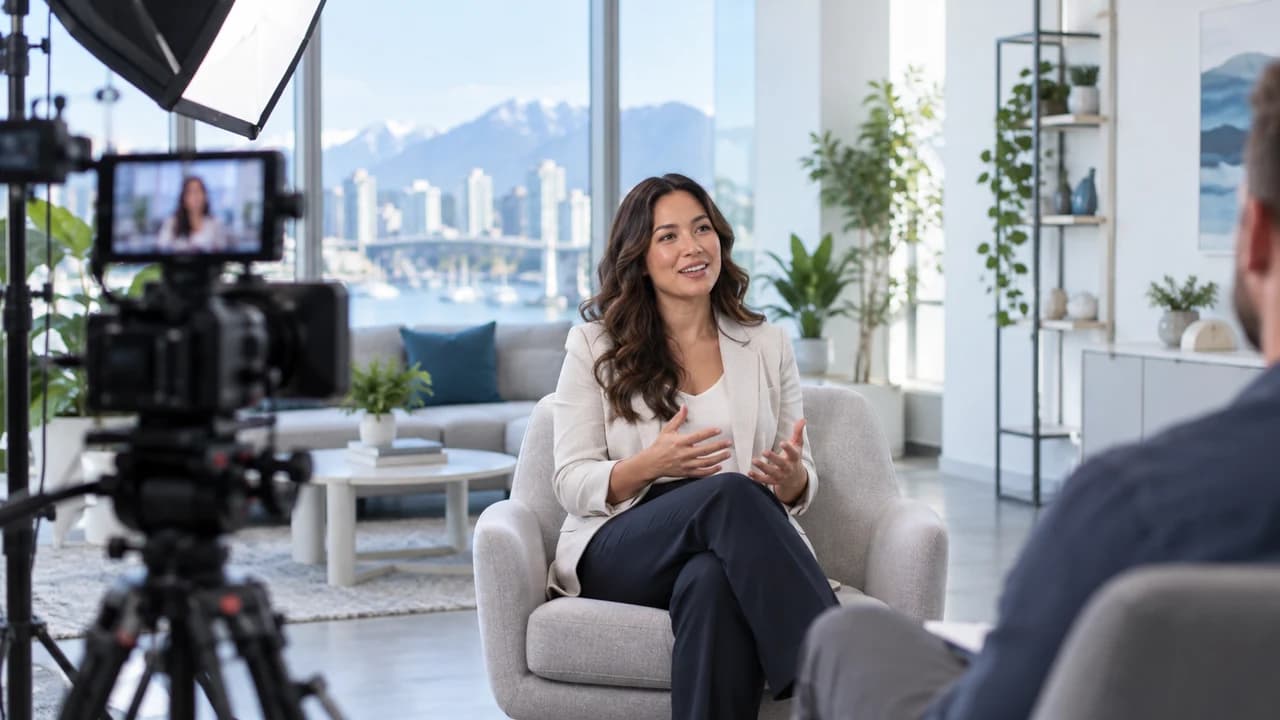
Customer testimonial video Vancouver builds trust with real client proof. Plan interviews, filming, and reuse.
Why customer testimonial video works better than brand claims
Customer testimonial video works because it shifts the speaker from the brand to an independent third party. A business can describe its own quality, speed, and value in any terms it chooses. A client who says the same things carries far more weight — not because the words are different but because the source is. For a Vancouver business, a genuine client account on video can answer the hesitation that most prospective buyers feel before making a first enquiry: is this company actually as capable as it claims?
Testimonial video is also durable in a way that written reviews are not. A written review can be read, misattributed, or dismissed as edited. A real person speaking on camera — with natural hesitations, genuine reactions, and an identifiable face — is difficult to fabricate and easy to share. Buyers who are comparing several suppliers in the same category often weight a credible video account above several pages of written testimonials.
For Vancouver professional service providers, contractors, real estate teams, healthcare practitioners, and creative studios, a short client video can do more conversion work than a detailed service page. It is not a replacement for clear service information; it is the human proof that makes that information credible. Corporate video production in Vancouver often includes testimonial segments as part of a broader brand production, but a standalone client story is a practical standalone investment as well.
How to identify and prepare the right client
The strongest testimonial is not always from the most effusive client. It is from the client whose situation closely mirrors that of your target buyer, who can describe the problem they brought to you and the result they experienced, and who can do so in plain language rather than marketing vocabulary. Prospective buyers connect with specificity: a particular challenge, a real result, a recognizable context.
Choose a client who works in an industry or context your target audience recognizes. A property developer describing a video production experience lands differently with a real estate audience than a generic endorsement. A non-profit director explaining how a fundraising film performed gives another non-profit concrete proof of what is possible. Relevance matters as much as enthusiasm.
Prepare the client in advance by having a brief conversation about what you want to capture, not a list of talking points to memorize. Share the core questions: what were you trying to accomplish, what made you choose us, what was the experience like, and what would you tell someone considering a similar project? Let them know the conversation will be relaxed and that you will take multiple passes if needed. Clients who feel comfortable and prepared deliver far more natural and useful content than those who feel like they are being put on the spot.
Production planning for a testimonial shoot
Testimonial shoots are typically simpler to produce than brand campaign films, but they still require thoughtful preparation. Choose a location that reflects the client's environment or yours in a professional way. A client's office, showroom, workspace, or a well-prepared neutral setting at your studio or a hired space all work. Avoid locations with uncontrollable background noise, busy foot traffic, or visual distractions that will pull attention away from the speaker.
Audio quality is more important than camera specification in a testimonial. A clear, well-recorded voice builds credibility; hollow, echo-heavy, or interrupted audio undermines it regardless of the quality of what the person is saying. If the location has HVAC, street traffic, or reverberant surfaces, address those constraints in the production plan.
For a single client testimonial, a straightforward interview setup with thoughtful framing and supporting b-roll — the client at work, a product in use, a space being shown, or a result being discussed — is usually more effective than an elaborate multi-camera production. The story is the asset; the production supports it. If you want to capture several client testimonials in a single production session, planning the logistics — transitions between locations, client availability windows, and coverage needs — in advance makes the day efficient. Contact us to plan a testimonial shoot around your client availability and launch timeline.
Interview direction and getting a natural performance
Most clients are not experienced on camera and will feel self-conscious when asked to perform. The best testimonial direction does not feel like direction. It feels like a conversation that happens to be filmed. Start with simple, low-stakes questions to get the client comfortable before moving into the core testimonial topics. Allow them to finish thoughts naturally; do not interrupt or prompt too quickly.
If a response is technically useful but a little stiff, ask the same question a different way or ask the client to describe the situation as if they were telling a friend. The second or third pass is often the most natural. Edit decisions happen afterward; you only need the usable version once, not on the first take. Leave a short pause after each answer so the editor has a clean transition point. Record room tone and a few listening reactions; both give the edit breathing space without changing the client's meaning.
Encourage specificity over generalization. A client who says the production team was professional is giving you a usable quote. A client who says they delivered the final film four days before the conference deadline, which allowed us to use it in the sponsor reception, is giving you a memorable, verifiable story. The more specific the account, the more a prospective buyer can picture themselves in the same situation.
Consent, review, and usage rights before publishing
A customer story depends on trust at both ends: viewers must believe the speaker, and the client must trust the business producing and publishing the video. Put the practical boundaries in writing before filming. Confirm where the finished video may appear, whether paid advertising is included, how long the permission lasts, whether the client's name, title, company, and logo may be shown, and who can approve the final edit. A simple release should match the actual distribution plan rather than asking for vague unlimited rights without explanation.
Build review into the schedule. The client should be able to check factual statements, name spelling, job title, and any sensitive business detail before publication. That does not mean offering an open-ended rewrite of an honest interview. Define one factual review round, identify the decision-maker, and set a response deadline. If legal, healthcare, financial, or regulated claims are involved, have the appropriate person verify them before the edit is locked. Never imply a measurable result that the client cannot support.
Also discuss what happens if the client's role or relationship with the business changes. Keeping the project file, clean interview selects, release records, and final approved wording organized makes future updates much easier. For a compact interview day, a freelance videographer in Vancouver can often keep the room relaxed while handling camera, lighting, and sound efficiently. Larger multi-client campaigns may need additional crew and production coordination. Choose the setup around the number of speakers, locations, deliverables, and approval requirements—not around an arbitrary idea of what a professional set should look like.
How to distribute and maximize testimonial video value
A testimonial video begins its work on your website and extends its reach through every channel your business operates. The homepage, a dedicated testimonials or case studies section, individual service pages where the client's industry is relevant, and a portfolio or work page are all natural placements for the full-length version. A shorter cut — 60 seconds or less — works well as a standalone social post, an email campaign asset, or a paid-social ad.
Testimonial clips also work inside proposals and sales presentations. A prospective client who watches a peer describe a positive experience during the evaluation process is more likely to move forward than one who reads a written endorsement in the same context. Export a version optimized for presentation playback if you use video in sales meetings.
Plan the distribution before the shoot so the editor knows what versions to build. A main 90-second or two-minute version for the website, a 60-second social cut, and a 30-second highlight clip are usually sufficient for most distribution needs. Captions are important on social platforms where audio is often muted by default. See our portfolio for examples of client-facing video work, and contact us when you are ready to plan a testimonial production.
Frequently Asked Questions
How long should a customer testimonial video be?
A main website version of 90 seconds to two minutes and a 60-second social cut cover most distribution needs. Viewers will watch a longer version if the story is specific and credible.
What makes a good client testimonial on video?
A relevant client in a familiar context, describing a specific problem and a concrete result in plain language. Specificity and natural delivery matter more than production polish.
Do I need multiple client testimonials or is one enough?
One well-produced testimonial from the right client is more effective than several generic endorsements. Expand the library as you accumulate clients whose context matches different buyer segments.
Can testimonial video be filmed remotely?
Yes. A video call recording can work for distribution when production quality allows — good lighting, a clean background, and a stable connection. In-person production typically yields better audio and a more natural performance.
Where should I use a customer testimonial video?
Homepage, relevant service pages, case study sections, proposals, sales presentations, email campaigns, and social media all benefit from testimonial content. Plan the versions before the shoot so editing is efficient.
Ready to start your project?
Get in touch for a free consultation. I typically respond within a few hours.