
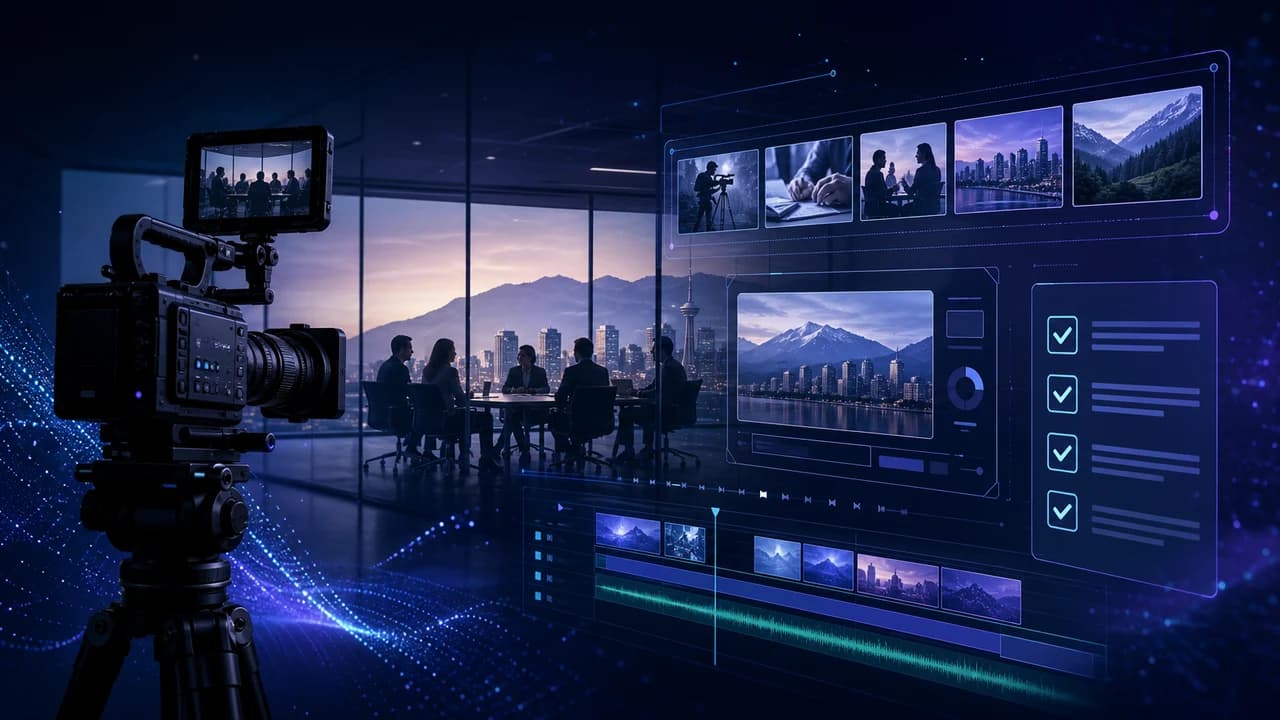
Corporate video production Vancouver guide for SMBs planning budget, timeline, deliverables, and proof-driven filming.
What Corporate Video Production in Vancouver Should Actually Do
Corporate video production Vancouver is not just about making a company look polished. For a small or medium business in Vancouver, Richmond, Burnaby, or Surrey, the video has to help a buyer make a decision: understand what you do, trust the people behind the service, see proof that you can deliver, and know what to do next. That is why the best corporate videos start with business intent before cameras, locations, or AI concept frames.
A useful corporate video usually answers five questions quickly: who you help, what problem you solve, why your approach is different, what proof you can show, and how someone can contact you. The opening 30 percent matters because viewers, search engines, and AI answer engines all look for clear facts early. If the video is for a Vancouver service page, include the city, service area, client type, deliverables, and timeline in the brief, not as an afterthought.
For many businesses, a practical project includes a 60-90 second website video, a 30-second LinkedIn cutdown, several vertical clips, captions, thumbnail options, and a short written summary for the page. A focused corporate video production Vancouver workflow turns one shoot day into multiple sales assets instead of one file that only lives on YouTube.
Start With the Buyer Journey, Not the Shot List
Before choosing camera moves, write the buyer journey in plain language. A corporate video for a professional services firm may need to reduce perceived risk. A manufacturing facility tour may need to prove capability and process control. A recruitment video may need to show culture and day-to-day work. A founder story may need to make the company feel human. Each goal requires different footage, pacing, and proof.
A simple pre-production brief should include the target audience, the one decision the viewer should make, the main objections, the final call to action, and the platforms where the video will appear. For Vancouver businesses, add local context: neighborhood, service area, language needs, season, parking or loading access, available staff, and whether filming must happen during business hours. These details affect schedule and cost more than most clients expect.
Once the goal is clear, the shot list becomes easier. Interviews provide credibility. Workplace b-roll proves process. Customer-facing moments show service quality. Product or space details create texture. Drone or exterior shots can establish place when location matters. If the audience is comparing local vendors, link the video to a real next step such as a quote form, consultation, or service page rather than ending with a vague brand message.
What to Film: Interviews, Proof, Process, and Local Context
A strong corporate video combines talking points with proof footage. Interviews explain the value proposition, but b-roll makes it believable. If a founder says the company is hands-on, show them walking the floor, reviewing work, greeting clients, or solving a real problem. If a team claims fast turnaround, show the process that makes speed possible. If a business serves a specific local market, show the real office, storefront, job site, or neighborhood context.
For SMBs, the most reliable structure is interview-led storytelling supported by planned b-roll. Capture the founder or manager answering short prompts: who the company helps, why customers choose them, what makes the process easier, and what a new client should expect. Then film the visual proof: team interaction, tools, products, workspace, client-facing moments, and details that make the business specific rather than generic.
Local production details matter in Vancouver. Rain plans, window light, street noise, building access, elevator bookings, and parking can all affect the shoot day. If the video needs exterior establishing shots or rooftop visuals, decide early whether drone videography in Vancouver is realistic for the location, weather, and airspace. Planning these details prevents a simple corporate shoot from turning into a rushed improvisation.
Budget and Timeline: What Changes the Cost
Corporate video cost is driven by scope, not only by video length. A one-camera interview with half a day of b-roll is very different from a multi-location shoot with two cameras, lighting assistant, drone, teleprompter, motion graphics, bilingual versions, and ten social cutdowns. When comparing quotes, ask what is included: planning call, script support, shoot hours, crew size, audio, lighting, editing rounds, color, licensed music, captions, aspect ratios, thumbnails, and delivery timeline.
For many small and medium businesses, the best value comes from a focused one-day shoot. The morning can cover interviews and controlled office scenes; the afternoon can capture process b-roll, exterior shots, team interaction, and social clips. That single day can produce a website video plus several short versions if the deliverables are planned before filming. If social content is important, shoot vertical moments intentionally instead of cropping everything later.
Timeline depends on approvals. A lean project can often move from brief to shoot within two to four weeks, then deliver the first edit within one to three weeks after filming. More stakeholders, scripts, compliance review, or multiple languages add time. If your video supports a launch, event, hiring campaign, or website redesign, build approval time into the schedule early.
How AI Fits Into a Corporate Video Workflow
AI can make corporate video planning faster, but it should not replace the proof layer. The safest use is before and after filming. Before the shoot, AI can help outline interview questions, summarize brand messaging, generate storyboard options, create mood boards, and prepare shot-list variations. After the shoot, AI can help transcribe interviews, identify sound bites, draft captions, and repurpose the main edit into blog summaries or LinkedIn posts.
Where AI becomes risky is when it tries to stand in for the real company. A synthetic office, fake staff, or generic AI b-roll may look impressive for a few seconds, but it does not prove that your Vancouver business exists, serves real clients, or has a trustworthy team. Corporate buyers are sensitive to authenticity. They want to see the actual people and process behind the promise.
The strongest hybrid workflow uses AI for speed and structure, then uses professional filming for trust. Generate concept frames to agree on visual direction, but film the real team. Use AI to organize transcripts, but let human editing decide emotional rhythm. If you need a broader production plan, review all video production services and choose which deliverables need real capture, which can be assisted by AI, and which can be repurposed after the main edit.
A Practical Checklist Before You Book
Before booking a corporate video, gather a short checklist. First, define the business goal: quote requests, recruitment, sales support, investor credibility, training, event follow-up, or brand awareness. Second, choose the primary platform: website, LinkedIn, YouTube, sales deck, email, trade show screen, or Google Business Profile. Third, list the deliverables: main video, vertical clips, subtitles, thumbnails, still frames, and bilingual versions if needed.
Fourth, identify who must appear on camera and who can approve the final edit. Fifth, prepare the location: quiet interview room, clean background, access instructions, brand materials, product samples, and any safety or privacy rules. Sixth, collect reference videos, but explain what you like about them: pacing, lighting, honesty, camera movement, or structure. This helps the production team translate taste into a practical plan.
Finally, think about the next customer action. A corporate video should not end as decoration. It should lead viewers to a service page, quote request, contact form, or follow-up conversation. If you already know your goal and rough deliverables, you can contact Steven Video Production with that checklist and get a clearer quote faster.
Frequently Asked Questions
How much does corporate video production cost in Vancouver?
Cost depends on shoot length, crew size, locations, scripting, drone needs, editing complexity, captions, and the number of final versions. A focused one-day SMB shoot is usually more efficient than an open-ended project because deliverables are planned before filming.
How long should a corporate video be?
For a website or landing page, 60-90 seconds is often enough. For LinkedIn or paid social, create 15-30 second cutdowns. Longer videos can work for training, internal communications, or detailed product explainers.
What should be included in a corporate video shoot?
Most projects need a planning brief, interview setup, clean audio, workplace b-roll, process footage, brand details, editing, color, licensed music, captions, and platform-specific exports.
Do small businesses need a script for corporate video?
Usually they need a message outline rather than a rigid script. Interview-led videos feel more natural when the speaker answers structured prompts, while scripted voiceover works better for explainers and product demos.
Can AI make a corporate video without filming?
AI can create concepts, storyboards, synthetic scenes, captions, and summaries, but it cannot capture your real team, location, customer interactions, or trustworthy proof. For most corporate marketing, AI works best alongside real filming.
Ready to start your project?
Get in touch for a free consultation. I typically respond within a few hours.