
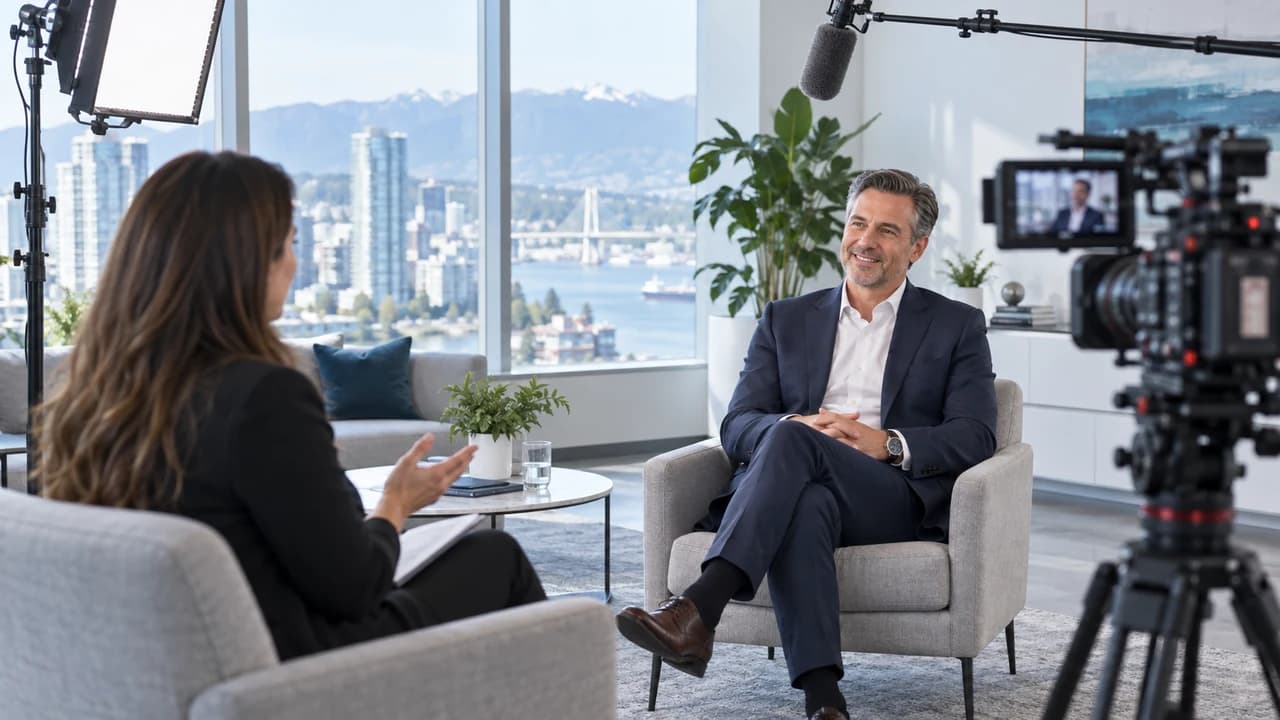
Corporate video interview Vancouver planning helps executives sound natural, stay on message, and film efficiently.
Start a corporate video interview Vancouver project with one clear outcome
Corporate video interview Vancouver planning should begin with the business outcome, not a list of camera questions. Decide what the viewer needs to understand, believe, or do after watching. An executive message for employees may need clarity and reassurance. A customer-facing company profile may need credibility and a concise explanation of value. A recruiting film may need the leader to describe culture in a way that feels specific rather than polished but empty. When the outcome is clear, the interview can be designed around evidence instead of slogans.
Write a one-sentence message goal before drafting questions. Then identify three supporting points the speaker can explain from direct experience. Those points might cover why the company made a decision, how the team solves a recurring client problem, or what makes the organization different in practice. Give each point a real example, process detail, or observable result. This creates usable answers while reducing the pressure on the executive to deliver a perfect speech.
Also define the audience and distribution channels early. A two-minute homepage film, a five-minute internal update, and six vertical leadership clips require different answer lengths and openings. Share the intended formats with the production team before filming so framing, eyeline, pacing, and supporting footage can be planned together. For help matching the message to the production scope, review corporate video production in Vancouver, then send the goal, audience, and preferred filming window through the contact page. A focused brief gives the speaker confidence because everyone knows what the conversation is meant to accomplish.
Design questions that produce complete, editable answers
Strong executive interviews feel conversational, but the questions are carefully structured. Start with easy factual prompts so the speaker can settle into the room: role, responsibility, the situation being discussed, and who it affects. Move next to decisions and reasons. Questions beginning with how, why, or what changed usually produce more useful material than questions that can be answered with yes or no. Finish with forward-looking prompts or a clear invitation to the audience.
Ask one idea at a time. A long question containing strategy, culture, results, and future plans forces the speaker either to ramble or to forget half of it. Break that question into four short prompts and listen for the natural follow-up. If an answer is vague, ask for a concrete example. If it depends on internal terminology, ask how the same idea would be explained to a new customer or employee. The interviewer should be prepared to depart from the list when a useful detail appears.
Answers also need to stand alone in the edit. The final viewer will not hear the off-camera question in many corporate videos, so encourage the speaker to include enough context in the first sentence. Instead of answering with it did, the speaker can say our Vancouver team changed the onboarding process because. This is not about sounding scripted; it is about giving the editor a clean beginning. Mark essential questions, optional questions, and topics that require legal or communications approval. That hierarchy protects the schedule and ensures the must-have message is recorded before attention drops or another meeting begins.
Prepare the executive without asking them to memorize a script
Memorized scripts often create the exact problem preparation is supposed to solve. The speaker starts monitoring every word, loses natural rhythm, and becomes visibly frustrated after a small mistake. A better approach is to prepare message blocks: the main point, two or three proof details, and the audience action. Send a short briefing document rather than pages of prose, and schedule a 20- to 30-minute pre-interview conversation when the subject or approvals are complex.
During that conversation, test which phrases the executive naturally uses. Capture accurate terminology, likely examples, and any claims that need verification. Explain that the filming session is a guided conversation and that answers can be repeated. Most executives relax when they know pauses are acceptable, imperfect starts can be removed, and the final cut will be reviewed. If exact language is legally required, isolate that statement and decide whether a teleprompter, cue card, or carefully rehearsed sentence is appropriate; do not turn the entire interview into a recitation because one line must be precise.
Ask the speaker to avoid scheduling a difficult meeting immediately before filming. Reserve arrival time for microphone placement, lighting adjustments, a sound check, and a few warm-up questions. Encourage normal hydration and a meal that will not create a last-minute rush. If several leaders are being interviewed, stagger their call times so one delay does not compress every session. An experienced Vancouver videographer can build these buffers into the call sheet and help each speaker understand the process before the camera rolls. Preparation should reduce cognitive load, not add another performance to the executive's day.
Choose a location, wardrobe, and schedule that support the message
The best interview location is not always the most impressive room. Prioritize controllable sound, enough physical depth for a clean background, access to power, and a space that can remain undisturbed. Boardrooms with glass walls may look modern but reflect lights and expose foot traffic. Large open offices can create constant voices, keyboards, alarms, and HVAC noise. Walk the location at the same time of day as the planned shoot whenever possible, because traffic, sunlight, and building activity can change dramatically.
Select a background that adds context without competing with the speaker. A real workspace, restrained brand detail, or view of the operation can support credibility. Remove confidential documents, unapproved logos, personal information, and visual clutter before the crew arrives. Schedule enough room for the camera, lighting, audio, interviewer, and a clear path through the set. If the office cannot provide reliable sound, consider a quieter meeting room and capture the active workplace separately as B-roll.
For wardrobe, recommend solid mid-tone colours and avoid tight patterns that may create distracting camera artifacts. The speaker should wear something aligned with how clients or employees normally see them. Bring a backup shirt or jacket when the appearance is business-critical. Glasses are usually manageable, but the crew may need time to adjust lights around reflections. Confirm accessibility, parking or loading, security check-in, elevator booking, and room availability in the production brief. These practical details determine whether the first hour is spent filming or solving preventable access problems.
Plan B-roll, approvals, captions, and short-form cutdowns before filming
An executive interview rarely carries an entire corporate film by itself. B-roll gives the editor visual evidence, covers natural trims between answers, and shows the organization at work. Build a shot list from the interview themes: leadership meeting with a real agenda, product demonstration, client-facing process, team collaboration, facility details, or the executive interacting with staff. Avoid generic staged activity that contradicts what the speaker says. If the interview promises careful quality control, capture the actual review step rather than people pointing at an unrelated laptop.
Plan permissions at the same time. Confirm which employees or locations can appear, whether screens contain confidential information, and who can approve product claims or customer references. Name one final decision-maker for the edit and gather consolidated feedback. Multiple reviewers can participate, but one person should resolve conflicting notes before they reach the editor. Set expectations for what each review round covers: factual accuracy and structure first, then small text, caption, or finishing corrections after the story is locked.
Captions and cutdowns should be part of the brief, not an afterthought. Identify whether the video needs open captions, selectable subtitles, a transcript, bilingual versions, or platform-specific vertical clips. A horizontal interview can support short-form content when the camera framing leaves room for a vertical crop or a second angle is planned. Review examples in the video portfolio to discuss pacing and visual treatment, but let the final format follow the audience and channel. Recording a clean master interview with intentional B-roll creates more options without promising that every possible version belongs in the original scope.
Make the filming day calm, repeatable, and easy to review
On filming day, protect the interview room from interruptions and give the executive a simple sequence: arrival, technical setup, warm-up, main questions, pickups, then B-roll. The crew should explain where to look, whether to address the interviewer or camera, and how to restart an answer. A good interviewer listens rather than racing through the list. Silence after an answer can encourage a useful second thought, while a short follow-up can turn a broad statement into a specific, credible example.
Record alternate versions of the most important message when time allows. One answer may work for the full corporate film, while a shorter version creates a stronger opening for LinkedIn or an internal update. Ask for complete sentences, but preserve the speaker's own vocabulary. If energy falls, pause instead of repeating the same question with increasing pressure. A brief reset, water break, or change in prompt often does more than another take. Before releasing the executive, review the must-have list and record names, titles, product terms, and calls to action with exact pronunciation.
After filming, document the approval path and delivery requirements. The first review should be judged against the agreed message goal, not against every unused sentence from the interview. Reviewers should provide time-coded, consolidated notes and distinguish factual corrections from preferences. Confirm spelling, titles, captions, logo versions, music approval, and export formats before final delivery. When the process is designed this way, executive preparation does not mean making the person perform like an actor. It means removing avoidable uncertainty so a knowledgeable leader can speak clearly, naturally, and with enough supporting material for a credible finished video.
Frequently Asked Questions
How should an executive prepare for a corporate video interview?
Prepare three message points, a real example for each, the intended audience, and the action viewers should take. Review themes rather than memorizing full answers, and allow time for setup and warm-up questions.
Should executives use a script or teleprompter for an interview video?
Use message notes for most interviews so delivery remains natural. A teleprompter can help with a short statement that requires exact wording, but reading every answer often sounds less credible and makes small mistakes more stressful.
How long does a corporate executive interview take to film?
The schedule depends on setup, location, question count, approvals, and B-roll. Allow separate time for camera, lighting and audio setup, the interview itself, pickups, and supporting footage instead of treating the interview length as the whole booking.
What should an executive wear for an on-camera interview?
Choose comfortable, professional clothing consistent with the audience's expectations. Solid mid-tone colours are dependable, while tight patterns and highly reflective accessories can distract on camera. Bring a backup option when appearance is critical.
What should be included in a corporate interview video quote?
Confirm the number of speakers and locations, filming window, crew and equipment needs, B-roll, final lengths and aspect ratios, captions or translations, review rounds, delivery deadline, and where the finished video will be used.
Ready to start your project?
Get in touch for a free consultation. I typically respond within a few hours.