
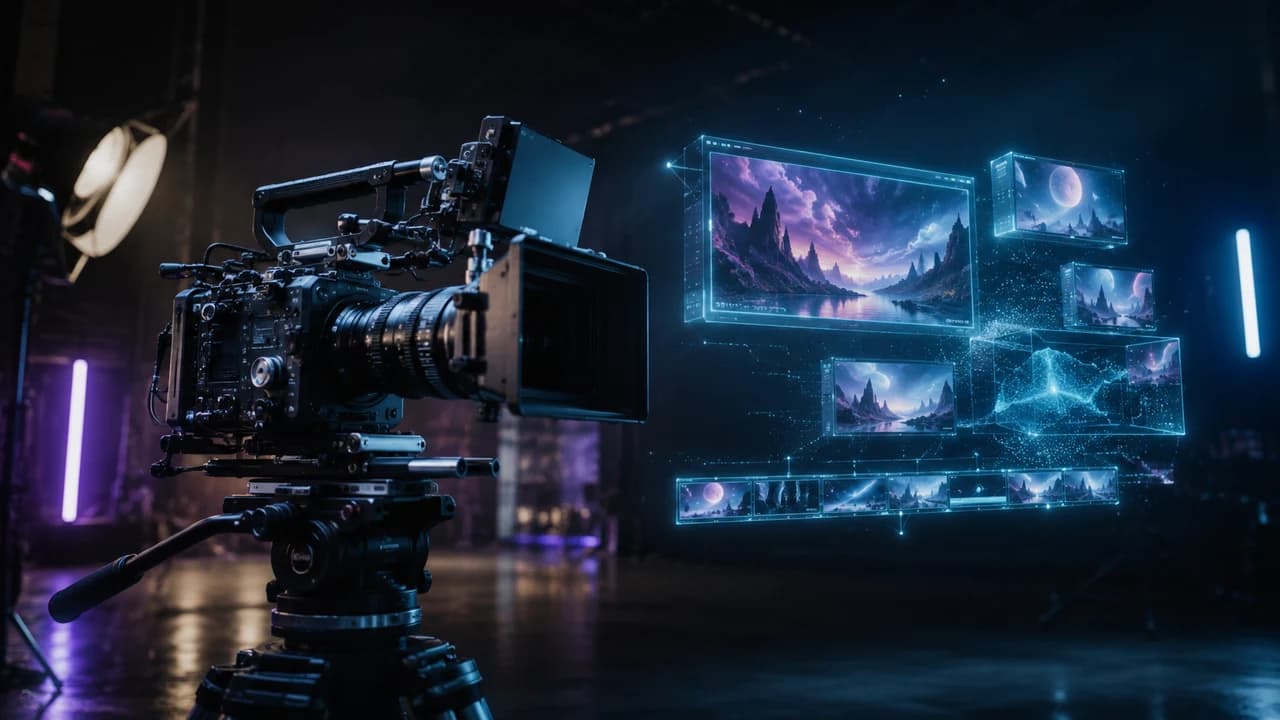
AI video vs professional videographer in 2026: which delivers better ROI for your business? Professional VFX analysts have stress-tested the leading AI video tools — and the results reveal a clear split. AI-generated video is genuinely useful for high-volume social content, but still falls short for brand films, testimonials, and property showcases that need to convert viewers into clients. This guide breaks down where each tool belongs in your video strategy.
The VFX Industry's 2026 Reality Check on AI Video
AI video vs professional videographer is the question most business owners are asking in 2026 — and the answer is more nuanced than the tool vendors want you to believe. Professional VFX teams recently put the leading AI video generators (including Seedance, Kling, and Veo) through rigorous frame-by-frame analysis, comparing them directly against footage shot on professional cinema cameras. The findings drew over 78,000 views from creators, marketers, and production houses trying to figure out where the technology actually stands.
The short version: AI video generation has improved dramatically in the past year. Establishing shots, abstract motion sequences, and stylized visuals that would have looked obviously artificial twelve months ago now pass casual inspection on a phone screen. For social media content — Instagram Reels, YouTube Shorts, LinkedIn video posts — AI-generated clips are genuinely competitive with footage shot on entry-level cameras by inexperienced operators.
But the analysis also revealed something the tech press tends to gloss over: the failure modes of current AI video tools are not random. They cluster in specific, predictable areas — and those areas overlap almost exactly with the types of video content that convert viewers into clients. Physics behaves strangely under pressure. Human hands and complex interactions degrade rapidly. Brand-specific environments — your actual office, your real team, your licensed product — cannot be reproduced by a model that has never seen them.
For businesses in Greater Vancouver making decisions about video budgets, this distinction matters. AI tools and professional production are not competing for the same job. Understanding which content category belongs to which tool is the practical skill most marketing teams are still developing.
Where AI Video Delivers Real Value in 2026
After the VFX analysis landed, the clearest takeaway for non-VFX professionals was this: AI video is excellent at generating content that establishes mood, context, and scale — and less reliable at anything that requires physical accuracy or genuine human presence.
For business use, that translates to a surprisingly useful list:
High-volume social media content. The biggest practical win for AI video is volume. A business that needs 15 social clips per month to maintain algorithm reach cannot afford professional production at that frequency. AI tools make consistent, watchable social content economically viable at any posting cadence. Seedance 2.5 and Kling 3.0 can generate professional-looking establishing shots, product environment clips, and atmospheric b-roll in minutes.
Abstract brand visuals. AI video excels at motion graphics-adjacent content: particle systems, data visualization, architectural flythrough concepts, and color-graded cinematic sequences that don't require physical accuracy. These work well as website background videos, presentation openers, and social story content.
Location atmosphere. For businesses promoting a general area — a neighborhood, a district, a type of property — AI-generated aerial and street-level visuals can stand in effectively for b-roll. For real estate video in Vancouver, AI-generated establishing shots of neighborhood parks or commercial corridors can supplement professional property walk-through footage at low cost.
Pre-production mockups. AI video is an underrated tool for client presentations — generating a rough visual proof-of-concept before committing to a full production budget. Many corporate video production projects now include an AI-mockup phase that helps clients visualize the final product without requiring a shoot day.
The common thread: AI video works best when the content doesn't require specific recognizable people, specific branded environments, or physical realism under close inspection.
5 Limitations That Still Matter for Business Video
The VFX community's frame-by-frame analysis identified failure patterns that are worth understanding before committing to an AI-first video strategy. These aren't random glitches — they're structural limitations of how current diffusion-based models handle video generation.
1. Physics degrades under pressure. AI video models interpolate motion between frames rather than simulating physics. This works fine for slow, simple movements — a camera push, a product rotating, a landscape pan. It breaks down visibly with liquids, fabrics in motion, hand contact with objects, and anything that requires momentum to carry across multiple cuts.
2. Human hands and faces remain unreliable. This is the most persistent failure mode across all current AI video tools. Hands in mid-interaction — pouring coffee, shaking hands, handling a camera — frequently distort by the second or third second of a clip. For business video that features your team, your service process, or your client interactions, AI-generated footage of humans is still too risky for professional contexts.
3. Your brand cannot be reproduced. AI models generate plausible versions of environments and products, not your actual ones. Your office, your logo on the wall, your specific van with your phone number, your product in the exact colorway you sell — none of these exist in the training data. Any client-facing video that requires authentic brand representation needs to be shot.
4. Architectural accuracy fails for specific locations. Vancouver landmarks, recognized buildings, and identifiable neighborhoods often get hallucinated details. For drone videography of specific properties or districts, AI cannot substitute for actual aerial footage.
5. Legal risk is still unresolved. The use of AI-generated video that depicts plausible real environments, brand identities, or human likenesses in commercial contexts carries unsettled legal exposure. Professional footage comes with clean rights chains. AI-generated footage does not yet have standardized clearance frameworks in Canada.
When Professional Video Production Delivers Better ROI
Understanding where AI video falls short points directly to the use cases where professional production delivers returns that no AI tool can match at any price point.
Client testimonials and case studies. The single highest-converting piece of video content for most service businesses is a real client speaking about a real result. No AI tool generates this. The authenticity that makes testimonial video convert is inseparable from the reality of the person, the space, and the moment. This is work for a professional camera, a real interview setup, and an editor who can find the three compelling minutes in sixty.
Brand films and corporate identity videos. A brand film is the video equivalent of a logo — it defines what your company is, what it values, and how it presents itself to the world. These are typically produced once every two to four years and anchor every other piece of content you produce. Cutting corners on brand identity video is a false economy: the savings on production cost far less than the brand equity lost to generic-looking visuals.
Property walk-throughs for premium listings. For real estate video in Richmond and Vancouver, AI-generated interiors consistently fail to represent actual spaces accurately. Ceiling heights, natural light quality, spatial flow, and finish quality — the details that drive purchase decisions — require a camera in the room. For listings above a certain price point, AI video is not a reasonable substitute for professional production.
[Event videography](/event-videographer-vancouver). Live events are unrepeatable. Conference keynotes, product launches, team milestones, and galas cannot be regenerated after the fact. Capturing them requires a professional on location with the right gear.
The pattern is clear: anywhere a potential client is going to make a significant decision based on what they see, professional video protects the moment that AI cannot reproduce.
The Hybrid Strategy: AI for Volume, Professional for Impact
The businesses getting the best results from video in 2026 are not choosing between AI and professional production — they are running both in parallel, assigning each to the content tier it serves best.
The practical version of this strategy looks like this:
AI-generated content (weekly cadence): Social media clips for Instagram Reels, LinkedIn, and YouTube Shorts. Atmospheric b-roll for service area pages and blog posts. Pre-production visual mockups for client presentations. Brand color and motion sequences for presentation templates.
Professional production (quarterly or per-project): Brand film and company overview video (annual or biennial). Client testimonials from recent projects. Property walk-throughs for real estate clients. Corporate video for pitches, trade shows, and executive communications. Drone footage of key locations or properties.
This split lets AI tools serve the algorithm — consistently feeding platforms the volume they reward — while professional production builds the assets that drive actual business decisions.
For Chinese-language video content in Vancouver, this hybrid model has particular value: AI tools can maintain posting frequency across WeChat Video, Xiaohongshu, and Douyin while quarterly professional shoots produce the authoritative long-form content that community audiences trust for major decisions.
The numbers support the approach. AI tools for business use run $25–$100 per month for unlimited volume. A professional production in Vancouver typically ranges from $1,500 to $5,000 per project depending on scope. One well-produced quarterly brand asset combined with AI-generated weekly social content costs less annually than full professional production at every tier — and performs better across the full content funnel than AI alone.
Quick Decision Framework: AI or Professional for Your Next Video
If you are planning a video project right now and trying to decide which approach fits, run it through these four questions:
Is this content repeatable? If the video depicts your actual space, your real team, a live event, or a specific moment that won't happen again — professional. If it's an atmospheric clip of a neighborhood or an abstract brand visual — AI can work.
Will this video be used in a high-stakes decision context? If a potential client will watch this video before signing a contract, booking a call, or making a purchase — professional. If it's awareness content that leads people toward your site — AI is fine.
Does it need to represent your brand specifically? Your logo, your team's faces, your actual product or property — professional. Generic industry visuals that could represent any company in your category — AI works.
What's the volume requirement? One well-produced video per quarter — professional. Fifteen social clips per month — AI makes the economics work.
The framing from the VFX analysis that stuck with most business audiences: AI video is excellent at making things look like a thing. Professional production is what you need when it has to be a specific thing. Both have a place in a modern video strategy — the skill is knowing which one fits the moment.
If you're working through this decision for an upcoming project — a brand refresh, a property campaign, a product launch — the services page outlines what professional production in Vancouver looks like at each scope level, and the typical timeline from brief to delivered asset.
Frequently Asked Questions
Is AI video good enough for business marketing in 2026?
For high-volume social media content — Instagram Reels, YouTube Shorts, LinkedIn clips — AI video tools like Seedance and Kling are genuinely competitive with footage shot on entry-level cameras. For content that drives purchase decisions (testimonials, brand films, property walk-throughs), professional production still significantly outperforms AI-generated footage in conversion rates.
Can AI video replace a professional videographer in Vancouver?
Not for the content categories that matter most to business results. AI video cannot capture your actual team, your real office or property, a live event, or a client testimonial. Professional videographers are also responsible for lighting, sound, direction, and the editorial judgment that turns raw footage into compelling content — none of which AI tools replicate.
What types of video content should still be professionally shot in 2026?
Client testimonials, brand films, corporate overview videos, premium real estate walk-throughs, live event coverage, and executive interviews should all be professionally produced. These are the content types that convert viewers into clients — and where authentic, brand-specific footage significantly outperforms AI-generated visuals.
How much does AI video cost compared to hiring a professional videographer?
AI video tools for business use typically run $25–$100 per month for unlimited clip generation. Professional video production in Vancouver typically ranges from $1,500 to $5,000 per project depending on scope, crew, and deliverables. The practical approach most businesses use: AI for weekly social content, professional production for quarterly brand assets — which costs less annually than full professional production at every tier.
Can I use AI-generated video for real estate listings?
AI-generated video works for establishing shots of neighborhoods, atmospheric visuals, and pre-listing social content. It does not work for property walk-throughs, interior showcases, or any content that needs to accurately represent a specific property. Buyers make high-value purchase decisions based on real estate video — AI-generated footage that misrepresents a space creates both trust problems and potential legal exposure.
What is the best AI video tool for Vancouver business marketing in 2026?
Seedance 2.5 leads for single-clip quality and cinematic output, particularly for establishing shots and atmospheric content. Kling 3.0 is stronger for multi-shot sequences with audio sync, which suits social media story formats. For businesses new to AI video, Kling's free daily quota is a low-risk starting point before committing to a paid plan.
Ready to start your project?
Get in touch for a free consultation. I typically respond within a few hours.