
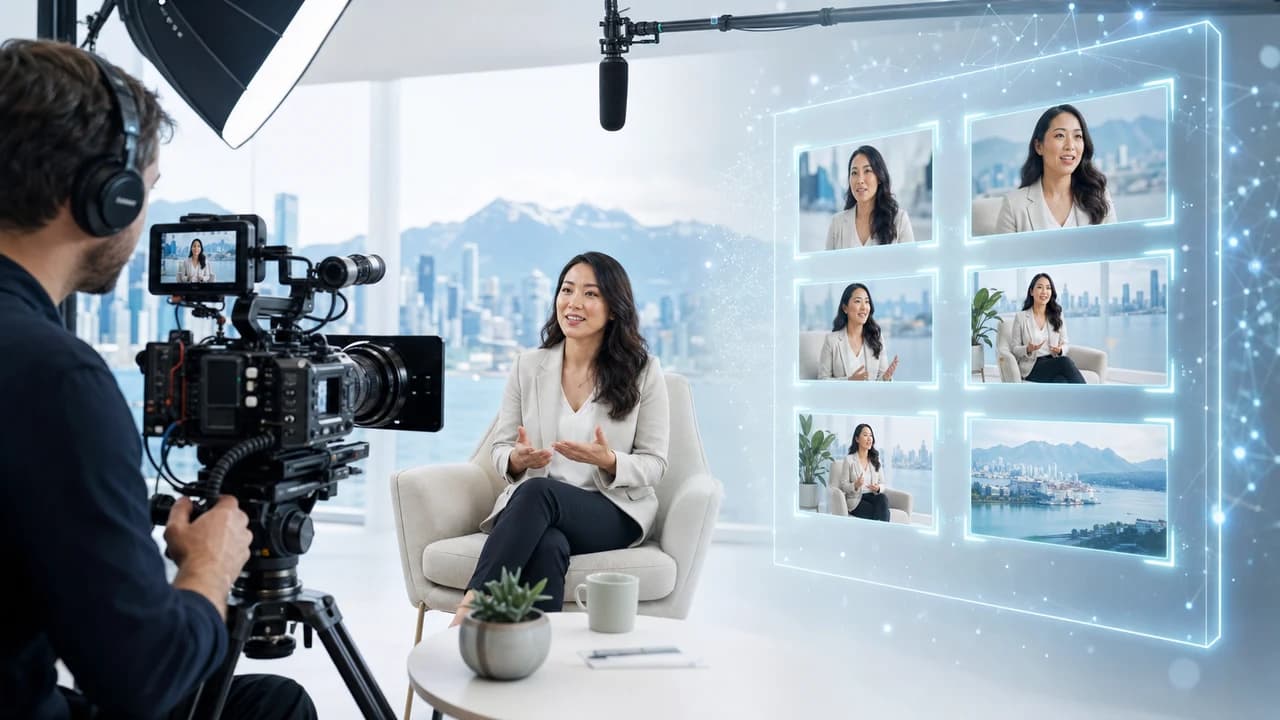
AI video production Vancouver teams can use AI for faster concepts and cutdowns while real footage keeps brand stories credible.
AI Video Production Vancouver Starts With the Job, Not the Tool
AI video production Vancouver is most useful when a brand begins with a clear production problem: explain a service, launch a campaign, create more social cutdowns, or make a complex idea easier to visualize. AI can accelerate selected stages, but it is not a substitute for deciding what the audience needs to see, hear, and believe. A local business still needs an accurate story, an approved message, and a practical plan for showing real people, places, and work.
For a Vancouver brand, start by separating footage that must be true from material that can be illustrative. A real customer-facing space, leadership interview, product demonstration, event, or construction site usually benefits from a professional shoot. Concept frames, transitions, abstract visual metaphors, early storyboards, and versioned social ideas can be good AI-assisted candidates. That distinction protects trust while giving the creative team more ways to test an idea.
The useful question is not whether AI replaces video production. It is where AI reduces repetitive work without weakening the evidence behind the message. A Vancouver AI video production service can turn that question into a shoot plan, a review process, and deliverables that suit the campaign rather than a novelty clip.
Use AI Before the Shoot to Make Better Creative Decisions
The highest-value AI work often happens before a camera rolls. A team can use it to explore visual directions, turn a rough brief into a first-pass storyboard, compare hooks for a short ad, or map one campaign into horizontal, vertical, and square deliverables. These are planning aids, not final proof. The client and producer should still check whether every proposed scene fits the actual location, brand standards, and audience expectations.
For example, an AI-generated mood frame may help a restaurant decide whether its campaign should feel lively, intimate, or premium. It cannot confirm that the dining room looks that way on a busy Friday night. A generated exterior concept can help plan a transition; the final location shot should show the real business. Bringing those decisions into pre-production means the shoot day focuses on the people and details that cannot be invented later.
A strong brief names the goal, primary audience, required facts, visual references, approval owner, and intended channels. It also calls out what cannot be altered: logos, product claims, regulated language, customer privacy, or the appearance of a physical location. When you pair AI concepting with Vancouver video production, the technology serves the message instead of pushing the project toward generic imagery.
Where AI Can Add Speed After a Real Brand Shoot
After filming, AI can be useful for organization and iteration. It may help a producer identify interview themes, make a transcript easier to search, produce a draft caption set, suggest a short-list of selects, or explore alternate pacing for a social cutdown. These capabilities can save time at the rough-cut stage, especially when a campaign needs several lengths and aspect ratios. They still require an editor who understands timing, continuity, brand tone, and what the footage actually shows.
AI-generated B-roll variations can also work when they are clearly illustrative: a stylized data environment, an impossible macro transition, a conceptual background, or a short visual bridge between real scenes. Keep the boundary clear. Do not use synthetic material to imply a product feature, a customer result, a workplace condition, or a location detail that was not actually documented. That is both a creative and a brand-accountability decision.
The most practical workflow is to edit the core story from authentic footage first, then use AI to support a specific transition, visual metaphor, or versioning need. That keeps interviews, demonstrations, sound, and customer-facing facts grounded while making room for efficient experimentation.
What Still Needs a Camera Crew and Human Judgment
Interviews, live events, team interactions, product demonstrations, on-location sound, and location-specific details are where real footage carries unusual value. Viewers notice small signals of authenticity: natural reactions, a working environment, the way a founder explains a decision, and the ambient details that establish place. A camera crew can also respond to the moment—adjusting lighting, framing an unexpected interaction, and collecting coverage that makes an edit feel intentional.
Human judgment is equally important in post-production. Someone needs to confirm names, claims, pronunciations, accessibility choices, licensing, music usage, release requirements, and whether an AI-assisted image could confuse the audience. A faster draft is not automatically a publishable draft. The person responsible for the brand should know what is synthetic, what is sourced, and what has been approved.
For recruitment, culture, customer stories, and leadership communication, the real people involved are often the point of the film. If your project needs credible interviews and location coverage alongside AI-assisted graphics, corporate video production in Vancouver can combine those elements into one accountable production process.
A Practical Vancouver Brief for an AI-Assisted Brand Video
Before requesting a quote, write down the business outcome: awareness, leads, recruitment, sales support, event attendance, or a better landing-page explanation. Include the audience, launch date, available locations, people who can appear on camera, brand assets, required claims, and the platforms that will carry the finished work. Then mark which ideas need real filming and which can be AI-assisted visuals. This makes a scope more useful than a vague request for an AI video.
Ask for a delivery list as well: a primary film, short cutdowns, vertical versions, captions, thumbnail options, and any paid-ad variations. Choose one person to consolidate feedback, and agree on how synthetic visuals will be reviewed before release. If a location or customer situation must look exact, make that a production requirement rather than hoping a generated scene will match it.
AI is valuable when it gives a Vancouver business more thoughtful options, faster iterations, and a better use of its shoot day. Real footage remains valuable when the audience needs evidence, place, voice, and accountability. To plan the right mix for your next campaign, contact Steven Video Production with your audience, deadline, and the parts of the story that must be real.
Frequently Asked Questions
What is AI video production in Vancouver?
It is a production approach that uses AI for selected tasks such as concepting, storyboards, illustrative visuals, transcripts, and versioning while using real filming and editorial review where authenticity matters.
Can AI replace a Vancouver videographer for a business video?
It can help with certain visual and post-production tasks, but it does not replace the need to document real people, locations, products, interviews, sound, and brand-approved facts.
Which parts of a brand video are best for AI?
Early visual exploration, storyboard ideas, abstract transitions, illustrative scenes, transcript organization, captions, and platform-specific cutdowns are often practical uses when a human reviews the result.
Should a company disclose AI-generated video elements?
The right approach depends on the campaign and audience, but teams should always review synthetic elements carefully and never use them to misrepresent a product, location, customer result, or real event.
How do I plan an AI-assisted video shoot?
Define the audience, business goal, required real footage, locations, deliverables, approval process, and which visuals are allowed to be illustrative before the project is scoped.
Ready to start your project?
Get in touch for a free consultation. I typically respond within a few hours.