
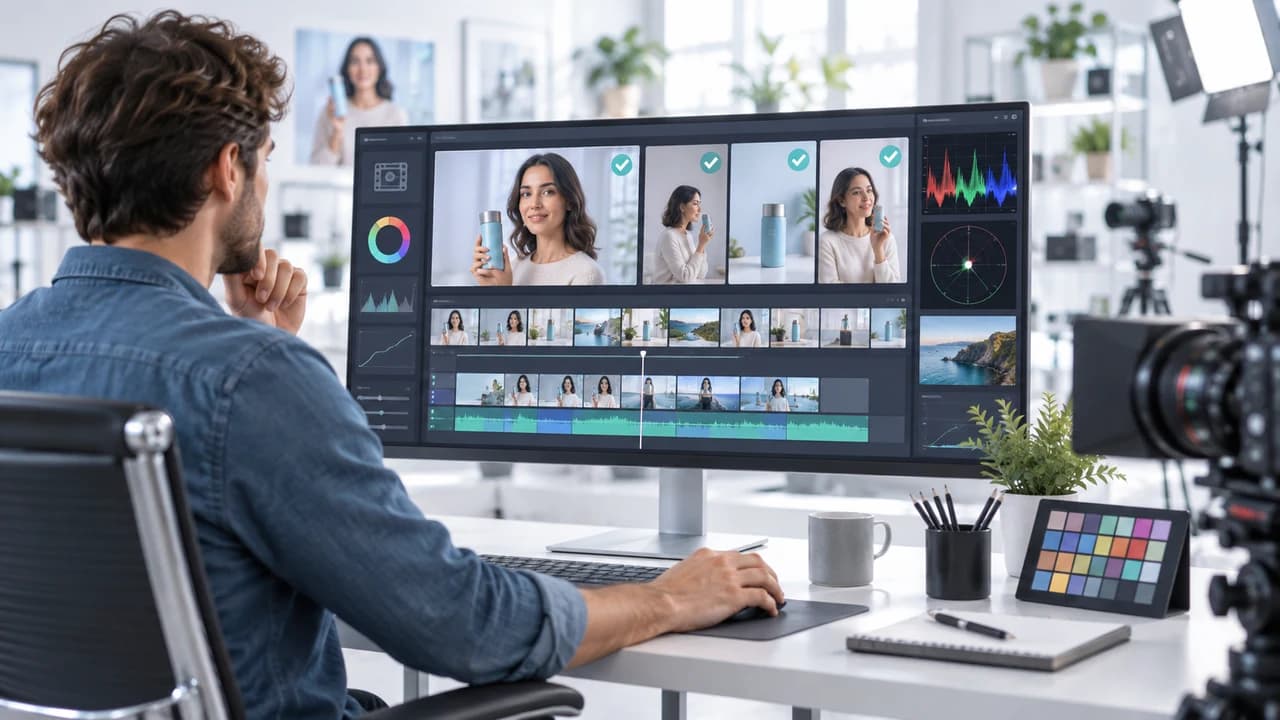
AI video production quality control protects brand accuracy, shot continuity and approval-ready delivery.
AI video production quality control starts before generation
AI video production quality control begins before anyone writes a prompt or presses generate. The first job is to define what must remain true in the finished film: the approved product shape, logo treatment, brand colours, spokesperson appearance, location logic, factual claims and intended audience. Without that reference, a visually impressive shot can still be unusable because it changes a package label, invents a feature or places the subject in an environment the client never approved. Quality is not simply resolution or cinematic lighting. It is whether every frame supports the agreed message without creating a new risk.
A practical project starts with a source-of-truth package. This may include approved product photographs, current logos, a brand guide, wardrobe references, location stills, legal wording, pronunciation notes and examples of visual directions to avoid. Each item needs an owner and version date. If the product is still changing, identify which details are locked and which are placeholders. If a real person must appear consistently, decide whether generated imagery is appropriate at all, and document the approved reference images and consent.
The creative brief should then translate those assets into acceptance criteria. Instead of asking for a premium result, specify what viewers need to recognize, which actions must be physically clear, what continuity should hold between shots, and which elements may vary. A human-directed AI video production service uses those criteria to judge outputs rather than rewarding generation volume. When the brief cannot distinguish a successful shot from an attractive failure, the project is not ready to generate.
Build a shot-level acceptance checklist
Every planned shot should have a short acceptance checklist. Start with narrative purpose: what new information or feeling does this shot add? Then check subject identity, product geometry, readable brand elements, hand and object interaction, background continuity, camera direction, light direction, motion, duration and safe framing for the required crop. A shot does not need to be perfect in isolation, but it must perform its job in the edit. A beautiful five-second clip that cannot connect to the previous or next frame is usually more expensive than a simpler shot that cuts cleanly.
Separate hard failures from preferences. A wrong logo, extra product button, altered uniform, impossible reflection, disappearing object, misleading property feature or broken hand-off between actors is a hard failure. Slightly warmer light or a less dramatic camera move may be a preference that can be handled in grading or editing. This distinction prevents stakeholders from spending review time polishing footage that should have been rejected immediately, while also stopping endless regeneration over details that do not affect the message.
Use a review sheet with the shot ID, prompt or source version, intended edit position, acceptance result, reason for rejection and next action. The next action may be regenerate, repair a region, composite an approved asset, replace the shot with real footage or remove it from the sequence. A professional Vancouver video production workflow treats generated clips as production elements, not finished truth. The checklist creates a traceable decision record and makes it easier for a client to understand why a polished-looking output did not pass.
Protect character, product and environment continuity
Continuity problems become obvious as soon as separate generations are edited together. A character's age, hair, clothing or eyeline may drift. Product dimensions, labels and reflections may change. A room may gain windows, move furniture or reverse its light between angles. Even when viewers cannot name the error, they feel the sequence is unstable. The solution is not one enormous prompt. It is a controlled reference system and an edit plan that limits what each shot must carry.
Choose continuity anchors before generating: a small set of approved character views, product angles, colour values, wardrobe details, location layouts and camera rules. Keep prompts and settings versioned, but do not assume the same words guarantee the same result. Review adjacent shots side by side and compare silhouette, screen direction, focal length impression, weather, time of day and action timing. For a product film, place an approved product image over the generated plate when accuracy matters more than synthesis. For a real property, event or testimonial, use real footage for evidentiary claims; generated imagery must not pretend to document something that occurred.
Editing can solve some continuity issues through cutaways, tighter crops, speed changes, sound bridges and colour matching. Compositing can replace a screen, label or controlled foreground element. It cannot responsibly rescue a scene whose core action is false or whose subject changes identity. Reviewing comparable video portfolio work helps stakeholders agree on the expected finish, but the production still needs project-specific references. Quality control is the process of knowing which differences an audience will accept, which can be repaired and which require a different production method.
Use a defined fallback when generation fails
A reliable AI video production plan assumes some shots will fail. The budget and schedule should not depend on unlimited retries producing the exact desired result. Before generation begins, rank shots by risk and define a fallback ladder. A low-risk atmospheric insert may allow several variations. A precise product interaction, accurate human performance or legally sensitive claim should have a stricter attempt limit and an alternate method ready. That alternative could be real filming, motion graphics, a still-image move, 3D, stock footage, a simpler composition or a rewritten beat.
Set a stop rule for each difficult shot. For example, after a bounded number of reviewed attempts, the producer compares the best candidate against the acceptance criteria and chooses repair, replacement or redesign. The number itself depends on the tool, shot and budget; the important point is that someone has authority to stop. Repeating generations without a decision framework consumes time while producing more files to review. It can also tempt a team to accept an inaccurate clip because of sunk cost.
Fallbacks should preserve the message, not imitate the failed technique at any price. If a generated spokesperson cannot maintain identity and believable speech, a real interview with designed supporting visuals may be stronger. If a product cannot be represented accurately, film the product and use AI only for backgrounds or transitions. If a scene would falsely imply a customer result, replace it with an honest illustration or clearly stylized concept. Human review adds value here: it protects the client's credibility while selecting the fastest method that can still meet the approved creative and technical standard.
Treat editing, sound, rights and approvals as part of QA
Generation is only one stage. The edit must control pacing, screen direction, colour, titles, captions, crops and the relationship between generated and real footage. Review the sequence at normal speed with sound, then again without sound to catch visual discontinuities. Check every required aspect ratio rather than assuming the vertical version will inherit the quality of the 16:9 master. Faces, products, captions and calls to action may move outside a safe crop, while compression can reveal edge problems that were not obvious in the source file.
Sound deserves its own pass. Confirm voice pronunciation, timing, room perspective, ambience, music transitions and loudness consistency. Synthetic dialogue or cloned voices require explicit permission and careful disclosure decisions. Music, stock assets, model inputs and generated outputs also need a rights review based on the project's actual distribution. A tool being available does not establish that every input is authorized or that every output is suitable for commercial use. Record the source of client assets and the licence or permission assumptions that affect delivery.
Stakeholder approval should use named reviewers and versioned exports. Ask the brand owner to check identity and visual rules, the subject-matter owner to check facts, and the project owner to consolidate feedback. Final QA covers names, logos, product details, claims, captions, sound, crops, file specifications and the approved distribution context. To plan a quality-controlled project, contact Steven Video Production with the audience, source assets, must-be-accurate details, intended channels and decision deadline. A clear approval path protects both creative momentum and the final release.
What today's AI video tool news does—and does not—change
The October 2 AI news brief highlights several workflow ideas relevant to quality control. ReelMimic describes an agent process that studies a reference video and plans a new piece in a similar style. Motion Video Kit emphasizes commercial-video templates and an independent critique loop. OneTake describes continuity checking for connected product shots. The brief also links to a Higgsfield demonstration of AI-assisted editing in DaVinci Resolve. These are useful signals because the conversation is moving from single-shot generation toward planning, review and edit integration.
They are not proof that a specific tool will preserve a client's product, character or claims. Public demonstrations, open-source repositories and tutorials need testing with owned or properly licensed assets before they enter a commercial workflow. A team should evaluate output accuracy, repeatability, data handling, review controls, export quality and the time required to fix failures. It should also keep a manual way to stop, replace or rebuild a shot. No agent or critique loop takes responsibility for a false visual claim; the producer and client still decide what is acceptable to publish.
For buyers, the better question is therefore not how many clips a system can generate. Ask what references are required, who rejects inaccurate shots, how continuity is checked, what happens after repeated failure, how real and generated footage are labelled internally, who reviews rights and facts, and which files you approve before release. An effective AI video production service sells a controlled path to an approved communication outcome. Tools may change quickly; the quality-control principles remain stable because they are tied to brand truth, audience trust and accountable human decisions.
Frequently Asked Questions
What is AI video production quality control?
It is the documented review process used to check brand accuracy, subject and product consistency, shot continuity, factual integrity, sound, rights, exports and stakeholder approval before AI-assisted video is published.
How do you keep characters consistent in AI video?
Use approved multi-angle references, lock wardrobe and identity details, version prompts and settings, compare adjacent shots side by side, and replace or redesign clips that drift beyond the acceptance criteria.
Can AI video accurately show a real product or property?
Not reliably by default. When accuracy is essential, use approved product imagery, compositing or real footage. Generated video should not be presented as evidence of a real property feature, event or testimonial.
What happens when an AI-generated shot keeps failing?
Use a pre-agreed stop rule and fallback ladder: repair a limited area, simplify the shot, composite an approved asset, use motion graphics or stock, film it for real, or rewrite the sequence.
How much does quality control add to AI video production cost?
It depends on shot risk, reference preparation, review rounds, compositing and delivery formats. A quote should separate generation from human direction, editing, factual review, rights checks and final QA.
Who should approve an AI video before publication?
Use named owners: brand reviewers for identity, subject experts for facts or claims, production reviewers for continuity and technical quality, and one authorized stakeholder for final release.
Ready to start your project?
Get in touch for a free consultation. I typically respond within a few hours.