
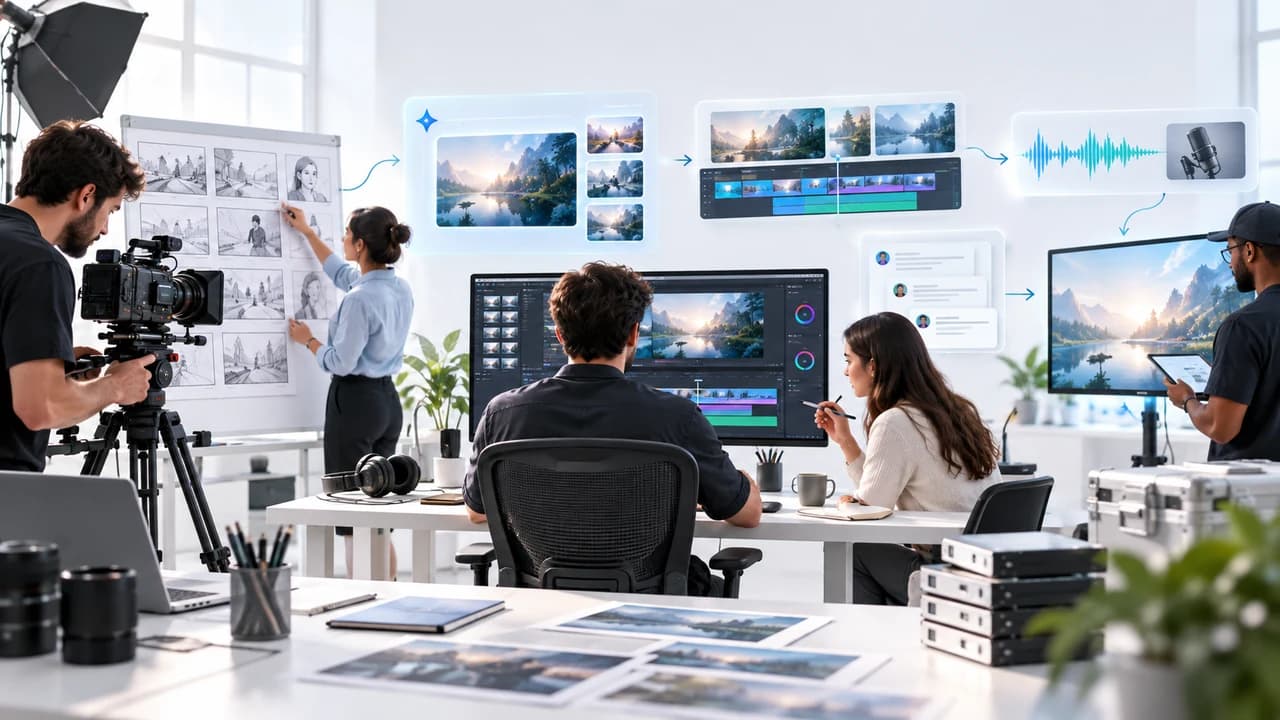
AI video production cost includes strategy, iteration, editing, sound, rights review, revisions, and delivery.
AI video production cost is more than a generation fee
AI video production cost is not the price of pressing Generate. The generation platform is one line in a production budget, while the finished business video depends on the work around it: defining the message, designing the visual approach, preparing reliable source assets, directing repeated attempts, selecting usable shots, compositing, editing, sound, rights review, revisions, and delivery. A cheap clip that cannot match the brand, connect to the next shot, or survive client review is not a low-cost result. It is an unfinished experiment.
Start with the business outcome. A ten-second product reveal for paid social, a stylized sequence inside a live-action brand film, and a fully generated sixty-second concept piece require different levels of continuity, factual control, and review. The same tool can be inexpensive for one assignment and wasteful for another. The useful question is not how much one generation costs, but how much approved, publishable video the workflow produces. That means estimating cost per usable shot and cost per final deliverable rather than cost per click.
Platform subscriptions, API fees, and generation credits can change. They should be checked on the vendor's official pricing or checkout page on the day the scope is prepared, then separated from creative and post-production labour. This article does not invent a fixed tool price or a fixed Steven Video Production package. It explains the work clients are buying so different quotes can be compared fairly. If you are considering an AI video production service in Vancouver, ask the quote to distinguish platform usage, production labour, licensed assets, revisions, and final outputs. That structure makes a changing tool market easier to manage without pretending the rest of the process is free.
Concept development and storyboards prevent expensive random generation
The first professional cost is decision-making. Someone has to translate a campaign goal into an audience, message, duration, channel, tone, factual boundary, and call to action. Without that brief, generation becomes a slot machine: attractive images appear, but each attempt explores a different film. The team spends credits and time discovering what should have been decided before production. A concise treatment reduces those branches by defining what the viewer sees, why each shot exists, and what cannot be visually changed.
Storyboards do not need to be elaborate illustrations. A practical board can use reference frames, rough compositions, lens and movement notes, intended duration, spoken line, and transition logic. For every shot, identify the subject, environment, action, camera behaviour, lighting, required brand detail, and relationship to the shots before and after it. Also mark whether the image may be stylized or must remain factually accurate. A generated atmosphere can be flexible; a product shape, property feature, safety procedure, or employee identity may not be.
This planning stage also determines whether AI should generate the whole image, extend real footage, create a background, produce an insert, or support previsualization only. Hybrid decisions often save more than choosing a cheaper model. A product can be filmed accurately while AI supplies an impossible environment. A presenter can remain real while generated visual metaphors appear around the interview. A difficult idea can be tested as a storyboard before a crew or location is booked.
Clients pay for this narrowing process because it reduces failed directions later. Ask whether a quote includes discovery, treatment, shot list, storyboard approval, reference selection, and a defined visual test. If those stages are excluded, clarify who supplies them. A low initial estimate can rise quickly when the production team must infer the message during generation and the client only discovers the intended film after seeing several incompatible drafts.
Asset preparation and consistency are separate production jobs
AI video rarely begins with a blank text box in a commercial project. The team may need approved logos, product photographs, packaging views, location plates, character references, colour standards, wardrobe details, previous footage, voice recordings, and examples of camera language. Each asset must be checked for quality, ownership, accuracy, and suitability before it enters the workflow. Poor inputs do not merely lower visual polish; they can create incorrect product details or inconsistent people that require repeated repair.
Consistency is one of the main differences between a demonstration clip and a campaign. A single striking shot can tolerate ambiguity. A sequence needs the same person, object, environment, screen direction, lighting logic, and visual style to persist as the camera and action change. That may require reference-image preparation, masks, clean plates, pose or depth guides, multiple controlled generations, and a record of the settings or prompts that produced each approved element. A change requested late in one hero frame can cascade into every related shot.
Selection also takes time. A producer may generate many candidates, reject obvious failures, compare motion and continuity, then present only the options that can support the edit. The client should not have to review an unfiltered folder of experiments. Editorial judgement is part of the service: choosing a frame that is not only beautiful by itself but also useful at the correct duration, crop, and transition point. You can review finished video work to discuss the standard the generated material must match rather than approving isolated frames without context.
A clear quote should state who prepares source assets, how many characters or products must remain consistent, whether reference photography is required, and what counts as a new visual direction. It should also say what happens when the client changes a product, wardrobe, location, or approved design after generation begins. These are scope changes because the underlying visual system may need to be rebuilt, not simple text edits that can be applied once at the end.
Iteration cost depends on usable shots, not the number of prompts
Generation is an iterative production phase. The first result tests the direction; it rarely guarantees the final shot. A team may adjust composition, timing, subject motion, camera movement, lighting, texture, physics, or the relationship between several references. Some attempts fail obviously. Others look convincing in the first frame but break during motion, reveal an incorrect detail, or cannot cut smoothly with the neighbouring shot. Evaluating those failures is labour, even when the platform returns a clip in seconds.
The best way to control this cost is to approve in stages. First approve visual direction with still references or a limited motion test. Next approve the hero subject and environment. Then generate the wider shot set, followed by selected refinements and final-resolution versions where needed. This checkpoint structure prevents a team from polishing twenty shots in a direction that one stakeholder has not accepted. It also makes client feedback more precise: changing the campaign concept is different from fixing motion in an already approved shot.
Quotes may handle iteration through a fixed test allowance, a defined number of shot attempts, a production-day or hourly allowance, or a custom scope based on complexity. None is automatically better. What matters is that the assumption is visible. Ask how many final shots are expected, what success criteria will be used, who approves the visual test, and when a requested change becomes a new direction. Do not compare providers only by the number of generations included; one disciplined workflow can produce more usable footage from fewer attempts than a large uncurated allowance.
Current creator workflows still return generated material to a conventional editor for assembly and finishing. That is an important budget clue: even a strong AI clip is usually an input, not a delivered campaign. The production cost therefore includes the person making continuity decisions across attempts, preserving approved details, documenting the workflow, and knowing when to stop generating and solve the problem through editing, compositing, sound, or a real camera instead.
Editing, compositing and sound turn clips into a finished video
Raw generated clips do not automatically share colour, exposure, pace, grain, sharpness, or motion language. Post-production makes them feel as though they belong to one film. The editor chooses exact in and out points, builds rhythm, replaces weak transitions, controls duration, and decides where live action, graphics, product footage, and AI material should meet. Compositing may remove artifacts, isolate foreground elements, add real brand assets, stabilize geometry, extend frames, track graphics, or combine several sources into one believable shot.
Sound contributes more to perceived quality than many visual demos acknowledge. A finished piece may need dialogue editing, voice-over, music selection and licensing, ambience, designed effects, transitions, mixing, and loudness checks for its destination. Generated audio, when used, still needs factual and creative review. Names, product terms, language, pronunciation, and emotional tone must be correct. Captions, transcripts, multilingual versions, and accessible delivery add further work that should be scoped rather than assumed.
Hybrid projects also need the same technical discipline as professional Vancouver video production: organized media, backups, colour management, approved graphics, channel-specific framing, and quality control after export. If the campaign combines camera footage with generated environments, the team must match perspective, movement, light, texture, and sound so the effect supports the story instead of advertising the tool. Sometimes the least expensive fix is a short practical pickup. Sometimes a generated insert avoids a costly location or build. The value comes from choosing correctly, not from forcing every problem through one model.
Ask a provider whether the estimate includes editing, compositing, colour, licensed music, sound design, captions, voice work, graphics, aspect-ratio versions, and master exports. A quote that lists only generated seconds may be describing raw material rather than a finished video. Compare the reviewable deliverable at the end of the process, including what will be ready to upload and what your own team would still need to complete.
Rights review, revisions and delivery belong in the quote
Commercial publication adds responsibilities that a personal experiment may not face. The team needs to know who owns or has permission to use the source photographs, footage, music, voices, logos, product designs, and reference materials. It should also identify whether generated content could misrepresent a real person, location, product function, property feature, or business claim. No production provider can replace the client's legal advice, but the workflow should create a review point where ownership, consent, factual accuracy, and intended usage are checked before release.
Revision cost depends on timing and decision ownership. One consolidated list from an authorized reviewer is faster than separate, conflicting notes from marketing, leadership, legal, and a client partner. The quote should explain how many review rounds are included, which milestones require approval, and what happens after an approved storyboard or visual direction changes. Corrections to a title are different from replacing a generated character across the full campaign. Clients can control cost by naming one feedback owner and resolving internal disagreements before notes reach production.
Delivery is also more than sending one high-resolution file. Define the number of master videos, lengths, aspect ratios, caption treatments, languages, file specifications, thumbnails, clean versions, and cutdowns that have a real publishing plan. Each output requires review and quality control. If editable project files, generation records, source assets, or archival storage are expected, include them explicitly; ownership and handoff terms should not be assumed.
The most useful budget conversation therefore starts with a brief, not a promise of cheap generation. Send the objective, audience, required facts, visual references, existing assets, final channels, deadline, and approval team. Ask for a base scope plus clearly priced options when the direction is still developing. To get a project-specific estimate, contact Steven Video Production with those details. A transparent AI video production cost should show the path from idea to approved delivery, reveal the assumptions that can change, and let you decide where AI saves time without removing the human work that protects the final result.
Frequently Asked Questions
How much does AI video production cost?
There is no reliable universal price. Cost depends on strategy, number and complexity of shots, asset preparation, consistency, generation attempts, editing, sound, rights review, revisions, and final versions. Request a scope that separates tool usage from production labour and deliverables.
Why does AI video production cost more than generation credits?
Credits create attempts, not an approved campaign. A professional result also needs a brief, storyboards, source assets, direction, selection, continuity, compositing, editing, sound, factual and rights checks, client review, and channel-ready exports.
Is AI video cheaper than live-action filming?
It can be cheaper for some impossible, illustrative, or previsualized shots, but not for every brief. Real products, people, locations, demonstrations, and trust-sensitive claims may be more efficient to film. Hybrid production often provides the best balance.
What should an AI video production quote include?
Look for discovery, concept, storyboard, asset preparation, generation assumptions, expected final shots, editing, compositing, sound, music or voice licensing, captions, review rounds, rights responsibilities, deliverable formats, and any platform charges.
How can a client reduce AI video production cost?
Approve the brief and visual test before scaling, provide clean owned assets, name one feedback owner, consolidate time-coded notes, separate essential shots from optional ideas, and define only the delivery versions that have a real publishing plan.
Can an AI video production company guarantee every generated shot?
Generation is variable, so a responsible scope should define tests, checkpoints, expected final outputs, and fallback methods rather than promise that every first attempt will work. Editing, compositing, a substitute shot, or live-action capture may be the better solution.
Ready to start your project?
Get in touch for a free consultation. I typically respond within a few hours.