
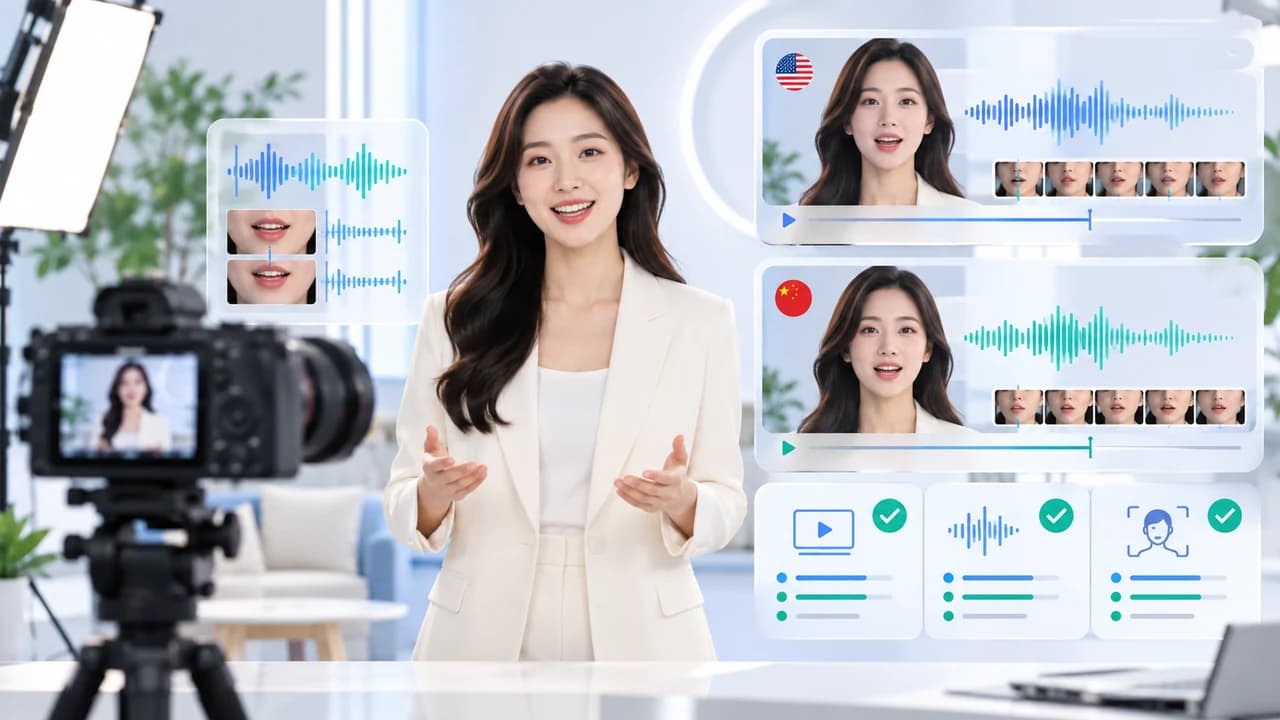
AI spokesperson video production Vancouver starts with one authorized 15-second bilingual approval test.
Start AI spokesperson video production Vancouver with one small decision
AI spokesperson video production Vancouver should begin with one authorized 15-second approval clip, not a full campaign. The test is small enough for a team to review carefully, but complete enough to expose the problems that matter: identity, permission, pronunciation, lip movement, timing, captions, brand tone and export quality. If those elements do not work in fifteen seconds, producing ten longer versions will only multiply the uncertainty.
Choose one useful line in English and one equivalent line in Chinese. They do not need to be literal translations, but they should make the same promise and lead to the same action. Use a real campaign sentence containing the company name, one product or service term and a short call to action. That gives the test meaningful pronunciation and factual requirements instead of letting it pass with generic speech. Keep the background, wardrobe and framing simple so reviewers judge the spokesperson rather than decorative effects.
Define the decision before production: approve the route, revise it once, or return to real footage. This is not a public ad and not proof that an entire campaign will work. It is a bounded production artifact that lets marketing, brand and the authorized person inspect the same file. Our AI video production service in Vancouver can structure the pilot around real delivery requirements rather than a tool demonstration. The goal is to spend a small amount of effort learning whether the approach is credible, controllable and worth extending.
Compare three production routes before choosing a platform
There are three practical routes to compare. The first is a real presenter recorded on camera, followed by normal editing, captions and bilingual versions. It provides the strongest identity evidence and the most dependable fallback. The second is an authorized digital likeness or avatar built from approved source material. It can help when a campaign needs many controlled variations, but the team must confirm the provider's current plan, region availability, voice and lip-sync support, consent process, data handling and export rights before uploading a face or voice. The third is a designed voice-over format: real product or workplace footage, motion graphics and an approved voice without a synthetic talking face. It often communicates the same message with less identity risk.
Today's AI news offers a useful warning against choosing by headline alone. Gradium's official Phonon page lists English, French, German, Spanish and Portuguese; it does not list Chinese, so it should not be assumed suitable for this bilingual test. Mistral's October 20 Voxtral 3 announcement describes broad multilingual speech support, but a broad language count is not a substitute for checking the exact target language, regional access, voice conditions and output in the product actually being considered. Vendor benchmarks are also not a listening test for your name, terminology or audience.
Put the three routes in one approval note and score each against the same needs: believable delivery, English and Chinese pronunciation, permission, editability, turnaround, final formats and a usable fallback. Do not select a talking avatar merely because it is novel. A well-shot real presenter or voice-over treatment may be the faster and more trustworthy choice for a corporate video in Vancouver. The winning route is the one that survives review and supports the campaign, not the one with the longest feature list.
Get permission and build a source-of-truth package
Before creating the test, identify every person and asset that requires permission. The spokesperson should knowingly approve how their image and voice will be captured, transformed, stored and used. A general appearance release for one camera shoot should not be silently treated as permission for voice cloning, a reusable digital likeness or future campaigns. Record the intended channels, languages, campaign period, editing scope and who can request new versions. If the person withdraws or changes roles, the organization also needs a practical stop-use and archive process.
Create a compact source-of-truth folder. Include approved name and title spellings, current logo files, wardrobe and background references, the English and Chinese scripts, a pronunciation sheet, the intended call to action and the exact framing or aspect ratios required. Mark which claims are final and who owns factual approval. Keep source files versioned so the team does not build the Chinese clip from an outdated English sentence or use an old job title.
The pronunciation sheet should be understandable to a human reviewer, not only to a speech system. Add a plain-language cue or recorded reference for the company name, personal names, product terms, abbreviations, place names and the final web address. For Mandarin or Cantonese, specify which language variety the audience expects instead of labeling everything simply Chinese. If the authorized speaker can record the line naturally, preserve that recording as the reference even when the production tests a synthetic route.
This package protects more than the AI stage. It gives the editor, caption reviewer and final approver one common standard. If the chosen tool cannot meet that standard, the same approved material can move directly into a real presenter or voice-over fallback without restarting the project.
Write a 15-second script that actually tests the hard parts
A useful test script is short, but it is not easy filler. Aim for one opening idea, one proof or offer and one action. At a natural pace, fifteen seconds usually leaves room for roughly one or two concise sentences; the exact word count depends on the language, speaker and required pauses. Read both versions aloud before generation. If the Chinese version needs noticeably more time to carry the same meaning, adjust the wording rather than forcing an unnatural pace to match the English waveform.
Include the terms most likely to fail. Use the real brand name, the spokesperson's approved title, one service phrase and the destination viewers should remember. Avoid packing the test with every campaign claim. The purpose is to judge whether the voice, face and timing can carry a representative message. Put legal or factual wording in the script only after the responsible reviewer has approved it. A synthetic delivery should never be used to make an unauthorized person appear to endorse a claim.
Prepare a small shot card beside the script. State whether the person looks into camera, how tightly they are framed, where captions sit, what safe areas must remain clear and whether the final campaign needs 16:9, 9:16 or both. For the first test, use limited head and hand movement. Large gestures, fast turns and busy foreground objects add lip-sync and continuity variables before the basic performance has passed.
Finally, name the files so reviewers cannot confuse versions: language, script version, production route, aspect ratio and date are enough. Keep the English and Chinese clips separate during review, then place them side by side only for comparison. A clean test design makes feedback specific: revise a pronunciation or timing choice, rather than vaguely asking for the whole clip to feel more natural.
Use an acceptance checklist, not a general thumbs-up
Review the approval clip at normal speed, with headphones, on a phone and on the largest screen where it may appear. Begin with identity: does the person look and sound like the authorized reference throughout the clip, without facial drift, altered age, unstable teeth, extra gestures or a voice that suggests a different speaker? Then inspect lip movement on names, numbers and sentence endings. Perfect frame-level matching is not the only goal; the delivery also needs believable pauses, emphasis, breath and eye behaviour.
Check language separately. Have a fluent reviewer listen to each version without reading the script first, then compare it with the approved text. Mark every mispronunciation, missing word, wrong tone, unnatural stress or phrase that sounds translated rather than spoken. Chinese narration must be listened to before any production approval. Automatic captions are not evidence that the audio is correct, so captions need their own spelling, timing, line-break and safe-area review.
Next check business accuracy and rights. Confirm the title, offer, product name, logo, visual setting and call to action. Verify that the approved person and the organization have agreed to this exact use, and confirm the selected route can export the resolution, frame rate, aspect ratio, clean master and caption files the campaign requires. Watermarks, plan limits, region restrictions or unclear commercial terms are rejection conditions, not details to discover after scaling.
End with one of three recorded decisions: approved for a defined next batch, revise specific test items, or use the real-footage fallback. Name the reviewer responsible for brand, language, identity and final release. A documented decision is more useful than a group chat full of reactions because the next production step can follow exact acceptance criteria.
Scale only what passed—and keep real footage ready
An approved 15-second clip does not automatically authorize every future script, language or channel. It approves the tested combination of person, source assets, production route, language, visual treatment and export conditions. Before scaling, decide what may remain fixed and what will change. A new offer may require factual review; a new language needs a fluent listener; a paid ad may require different rights; a vertical crop may expose facial or caption problems that were invisible in the widescreen test. Expand in a small batch and run the same checklist again.
Keep the real-footage fallback practical. That may mean recording the authorized spokesperson delivering both short lines during a corporate filming session, capturing neutral listening and gesture shots, and recording clean room tone. The real version can become the final video if the synthetic test fails, or it can anchor a hybrid edit while AI supports backgrounds, graphics or alternate visual ideas. The fallback should not be a threat or an afterthought; it is what makes the test a controlled production decision rather than a bet on one tool.
When requesting a quote, send the intended audience, languages, authorized spokesperson, draft line, pronunciation risks, final channels, aspect ratios, deadline and approval owners. Ask for the 15-second pilot as a distinct milestone, with its source requirements, included revision, acceptance criteria and fallback stated clearly. Search volume for this long-tail topic is currently unknown, so the business case should come from a real campaign need rather than an invented demand claim.
To scope an authorized bilingual pilot, contact Steven Video Production with those details. The first deliverable should answer one useful question: can this spokesperson approach represent your brand accurately in English and Chinese? If the answer is no, fifteen seconds is exactly the right place to find out.
Frequently Asked Questions
How much does an AI spokesperson video cost in Vancouver?
Cost depends on permission and source preparation, the chosen production route, language review, revisions, editing, captions and delivery formats. Start with a separately scoped 15-second pilot instead of pricing a full campaign from generation credits alone.
Can I clone an employee's face or voice for a company video?
Only with clear, informed permission that covers the intended image or voice transformation, channels, languages, duration and reuse. Do not assume a standard filming release automatically covers a reusable digital likeness or voice clone.
How do you test Chinese pronunciation in an AI spokesperson video?
Use an approved script and pronunciation sheet, then have a fluent Mandarin or Cantonese reviewer listen without relying on captions. Check names, tones, product terms, rhythm and whether the wording sounds naturally spoken.
Should an AI spokesperson replace a real presenter?
Not automatically. Compare an authorized digital likeness with a real presenter and a designed voice-over route. Real footage may be more credible and controllable, while a hybrid approach can use AI only where it adds clear value.
What should be approved before making a full AI spokesperson campaign?
Approve identity and consent, both language performances, pronunciation, lip-sync, claims, captions, brand details, commercial and export conditions, aspect ratios, reviewers and a real-footage fallback.
How long should an AI spokesperson test clip be?
Fifteen seconds is a useful pilot length because it can contain a real brand line, a difficult term and a call to action while remaining small enough for focused review. The full campaign length should be decided only after the test passes.
Ready to start your project?
Get in touch for a free consultation. I typically respond within a few hours.